Sunday, July 26, 2015

The Disappearance Of Lady Frances Carfax--A Very Pretty Hash, Indeed!

Sherlock Holmes is, no doubt, a great detective, and a great friend of John Watson.

Except, of course, when he isn't either of those things.

Which bring us to The Disappearance Of Lady France Carfax.

There are a lot of nice touches in this story.  The dialogue is crisp, the villains' plan seems clever (until you think about it for 10 seconds), there is great action, and a last-minute rescue.

But boy oh boy, I really think that Sir Arthur Conan Doyle blows this tale in several way. Holmes is a particular jackass to Watson, when Watson clearly doesn't deserve it. Holmes behavior in investigating the case is extremely illogical, and in all honesty he does not much to solve the case--if the villains aren't stupid, they get away. The behavior of our little criminal gang makes no sense, as it is never explained why they go from con artists to kidnappers and murderers. And at the end, Holmes (and Doyle) seem completely disinterested in the fate of the victim of these crimes, and the story gives us zero closure.

All in all, it's very irritating, as the negatives quickly overwhelm the positives in the story.

For the investigation of this case, Holmes sends Watson to do his legwork for him. It's not the first time, and it can be good to see Watson in solo action. But unlike Hound Of The Baskervilles, this time when Holmes surprisingly turns up in the middle of the story, he doesn't praise Watson, but archly criticizes him:
"A very pretty hash you have made of it...And a singularly consistent investigation you have made, my dear Watson," said he. "I cannot at the moment recall any possible blunder which you have omitted. The total effect of your proceeding has been to give the alarm everywhere and yet to discover nothing."
 Well, this may the most unfair thing Sherlock has ever said to John.

As to "giving the alarm everywhere," how is that? The villains have no idea that Watson is on their trail. As to confronting Philip Green, Holmes did the very same thing himself just a few hours later!! Granted, it didn't end in a violent fight, but that was hardly Watson's fault. And Watson found out that the "Shlessingers" and Lady Carfax had headed for London weeks ago--so seriously, what more did he expect Watson to accomplish?

We also cannot fault Watson's identification of Green as the likeliest suspect. Given that Watson doesn't have Holmes' encyclopaedic knowledge of European con men, he had no reason to suspect the Shlessingers. And Holmes certainly could have been more forthcoming in his cables--he's deliberately leaving Watson at a disadvantage, and then berating him for it!

But looked at through modern eyes, Philip Green is clearly--very clearly--a dangerous stalker who was a threat to Lady Frances, physically and emotionally. In a modern mystery there would be no doubt about how dangerous he was (even if he didn't turn out to be the actual culprit).

Note that we never get to consult with Lady Carfax in this story, so the only tale of Green's relationship with her comes from his perspective:
I was a wild youngster, I know--not worse than others of my class. But her mind was pure as snow. She could not bear a shadow of coarseness. So, when she came to hear of things that I had done, she would have no more to say to me. And yet she loved me--that is the wonder of it!--loved me well enough to remain single all her sainted days just for my sake alone.
A nice enough story; yet "she wouldn't marry me, but she wouldn't marry anybody else because of me" is fairly obviously self-serving, and likely somewhat delusional.

Again, we don't hear from Frances, but what are the eyewitness accounts of their meetings on the continent? As Watson tells us, "He had been seen talking earnestly to Madame on the promenade by the lake. Then he had called. She had refused to see him." Her maid's account gives us more chilling details: "With her own eyes she had seen him seize the lady's wrist with great violence on the public promenade by the lake."

It sure doesn't like as if she loved him, does it? "...[B]ut many little signs had convinced the maid that her mistress lived in a state of continual nervous apprehension." And Marie added, "She believed that it was out of dread of him that Lady Frances had accepted the escort of the Shlessingers to London."

This is classic stalker/victim behavior, isn't it? He approaches her, she rebuffs him, he loses his temper, she refuses to see him when he calls again, she seeks protection from being alone with him, and she is clearly in an emotionally upset and fearful state. Add to that the fact that when Frances left Lausanne, "there had been some secrecy, which confirmed the idea that she had gone with the intention of throwing someone off her track," a clear indication that she did not want Mr. Green's company!!

Watson's conclusion, far from being a blunder, rings chillingly true: "Here was this good and pious lady pursued from place to place by a sinister and unrelenting figure. She feared him, or she would not have fled from Lausanne. He had still followed. Sooner or later he would overtake her." Every single part of that was correct.

Green himself admits to some dangerous tendencies, although he tries to make light of it. His violent attack on Watson? "Indeed, I'm not responsible in these days. My nerves are like live wires." Just because the Doctor dared question him about Lady Carfax. And his "wooing" of her? "I found her at Lausanne and tried all I knew. She weakened, I think, but her will was strong, and when next I called she had left the town." By his own words, she said no, and he was trying to break down her will!!

A violence-prone suitor who won't take no for an answer, and follows her across continents, driving her into a state of fear and tension? This is the man in whose care Holmes left lady Carfax at he end of the story: "And here is someone who has a better right to nurse this lady than we have. Good morning, Mr. Green."

GOOD GOD, MAN, HE'S HER STALKER!!!! He's part of the reason she needs to be nursed!?!? What the hell, Sherlock?!?!?!?!

Despite his insistence that he had already done better, Holmes investigation makes little sense, either. Watson telegrams him that the party had left for London three weeks ago. Why, in heaven's name then, does Holmes come to Montpelier, when the missing woman and those he think responsible for her disappearance are thought to be in London?

His explanation makes little sense: "...finding that he could get away from London, he determined to head me off at the next obvious point of my travels." What? He could have sent you a telegram, John!! Instead, he wastes two days traveling to meet you for no real purpose, when he could have spent that time searching for the criminals and their victim! Seriously--the lady is missing, Holmes fears her in the clutches of terrible villains, her life in danger, and knows they left for London. So what possible reason is there to come to France, to a city where Carfax and the Shlessingers never went?! Unforgivable, and unexplainable, except that Sir Arthur wanted to have Holmes pull off one of his patented "disguise that fools even Watson" tricks.

The other blunder in the story is Sir Arthur's portrayal of what, exactly, Holy Peters' plan is.

Holmes initially portrays him as a con man: "His particular specialty is the beguiling of lonely ladies by playing upon their religious feelings..." He fleeces lonely women out of money. Yet, somehow, he and his wife graduated to kidnapping and murder?

Holmes lays out clearly enough that the kidnapping is motive for the murder: if they let Lady Carfax go, she will of course turn them into the police. Therefore, to keep her silent, they must kill her.

But...Holmes himself tells us that "these people had never, to my knowledge, done a murder." Which means, most likely, they had never resorted to kidnapping before, right? They get women to give them checks and cash for their "spiritual work," maybe in an extreme case actually burgle their jewelry...so what in the heck happened this time? How did they go from being grifters to physically imprisoning a noblewoman for over 4 weeks, and then trying to kill her, when Holmes told us they had never done anything of the sort before?

Did they discover the her jewels were incredibly valuable, and couldn't find a way to get them peacefully? Did she somehow discover that something nefarious was going on, and was going to the police to tell them of the Peters' scams, and they over-reacted by hitting her or something, and decided that they had no choice now but hold her hostage? Why wait 4+ weeks to start selling off the jewels? If they had done it weeks earlier, before Holmes got the word out to pawn-brokers, they never would have been caught! Why the very elaborate scheme to kill her, if they had just planned on vanishing afterwards anyway?!?

So Holmes (and Doyle) did indeed make a very pretty hash of it. Holmes chastises Watson for a fine investigation, and for zeroing in on the most likely suspect. Holmes' investigation leaves much to be desired, and he ends up leaving the victim in her stalkers' care!! And Holmes can't seem to make up their minds whether the criminals are grifters or sadistic murdering masterminds, or why they make the gruesome transition.

For these reasons, as well as some others we'll discuss below, The Disappearance Of Lady Frances Carfax is rather disappointing, despite some clever touches.

OTHER TRIFLES AND OBSERVATIONS:

**I've got to get this off my chest first thing: There is an outfit here in America called CARFAX, that helps you shop for used cars and can (for a fee) provide a complete repair history of the vehicle you're interested in buying. The premise of the commercials is customers demanding that the dealer provide them with a CARFAX report, with the tagline "Show me the CARFAX!"

So, that was bouncing around my head the whole time with this story...

**The Granada adaptation once again contained many differences. I'm lazy today, so I'll just cut and paste the Wikipedia summary:
The action takes place entirely in the Lake District of England, where the holidaying Doctor often sees the Lady (and her stalker Philip Green) at the hotel before her disappearance; she has a brother; her jewellery is French rather than Spanish; no mention is made of the maid; Peters is not Australian and does not have a bitten ear, but is in a wheelchair; Green made his fortune in Australia rather than in South Africa; there is no police intervention at the house; the coffin is opened at the cemetery rather than at the house; Lady Frances is traumatised by her experience (though Holmes says that "There is every hope of a full recovery"); and Holmes acknowledges the case as one of his few true failures and refuses to be rewarded by Green.
So, yeah, a little bit different.

Sometimes I wonder if the writers of the Granada adaptations were paid by the number of pointless changes they make to the original story...

**This is the first time in some while that we've begun a story with the "Holmes baffling Watson with some personal deductions" in awhile. I had thought that Sir Arthur had just grown tired of the device. But it's back!

**Watson getting persnickety at Holmes' sauciness: "I don't admit that a fresh illustration is an explanation," said I with some asperity. "Bravo, Watson! A very dignified and logical remonstrance."

**One of Holmes' most famous epigraphs:
One of the most dangerous classes in the world," said he, "is the drifting and friendless woman. She is the most harmless and often the most useful of mortals, but she is the inevitable inciter of crime in others. She is helpless. She is migratory. She has sufficient means to take her from country to country and from hotel to hotel. She is lost, as often as not, in a maze of obscure pensions and boardinghouses. She is a stray chicken in a world of foxes. When she is gobbled up she is hardly missed."
This could have been the starting point for us to have a discussion about the role of single women in Victorian/Edwardian England. But sadly, the story gives us nothing else. We never meet a conscious Lady Frances; we never learn the specifics of how she was entangled with the Shlessingers; we know precious little about her life.

Yes, she was pursued by a stalker, but Holmes is unconcerned with that, and it could as likely happened at home. Yes, she fell in with some con men, but they were usually non-violent. And her being "lost" initially is her own decision, to hide her movements to put off Green.

So it's hard to say if this is just another example of Holmes' sexism, or if the "drifitng woman" really was a problem of the era.

**Just how wealthy was Lady Frances Carfax?

We get conflicting signals. Her family estates went to "the male line," so "she was left with limited means, but with some very remarkable old Spanish jewellery of silver and curiously cut diamonds to which she was fondly attached."

But Lady Frances is traveling the continent, staying in luxurious hotels. She gives her maid £50 as a wedding gift. She leaves Lausanne on a day's notice, paying a week's rent for the early departure.

She has the remarkable jewelry, which the criminals coveted; but there is no evidence that they made any attempt to access her bank account. She allowed the Reverend Doctor Shlessinger to pay her hotel bill, and apparently for her travel. Was she broke after that extravagant gift?

Despite the fact that Holmes describes Lady Frances as "the last derelict of what only twenty years ago was a goodly fleet," her family certainly isn't poor: "The family are anxious, and as they are exceedingly wealthy no sum will be spared if we can clear the matter up."


That comes in consecutive paragraphs. Sloppy writing? Or is Holmes just speaking relatively of her "limited means"--rich to you and I, but a pauper compared to her family?

**Holmes: "Single ladies must live, and their passbooks are compressed diaries."

A wise observation...although in this case the bank account did nothing to solve the mystery. And how did Holmes get that information? Did he get the information from the family? Or did he do another trick to (illegally, no doubt?) wheedle the information out of the bank?

**Apocryphal case: "old Abrams is in such mortal terror of his life" that Holmes cannot leave London.

**Again Holmes is too bust to take up an important case. Not only is the Abrams case keeping him busy, but "on general principles it is best that I should not leave the country. Scotland Yard feels lonely without me, and it causes an unhealthy excitement among the criminal classes."

Pithy, and perhaps more full of self-praise than we're used to seeing from Holmes. But of course, just a few days later Holmes does leave the country, quite unnecessarily.  Was the Abrams case cleared up (or was he dead?!)?

**Victorian con men: Lady Carfax...
...found the acquaintance of a Dr. Shlessinger and his wife, a missionary from South America. Like most lonely ladies, Lady Frances found her comfort and occupation in religion...Dr. Shlessinger's remarkable personality, his whole hearted devotion, and the fact that he was recovering from a disease contracted in the exercise of his apostolic duties affected her deeply.
Later we learn...
...The Rev. Dr. Shlessinger, missionary from South America, is none other than Holy Peters...His particular specialty is the beguiling of lonely ladies by playing upon their religious feelings, and his so-called wife, an Englishwoman named Fraser, is a worthy helpmate
This is one bit the Granada adaptation keeps, and expands on. "Shlessinger" uses fake slide shows and testimonials of his good works to bilk donations from other guests and the local church.

As to whether "most lonely ladies" find solace and occupation in religion? And whether that made them more vulnerable to being scammed? Well, remember, this is Watson speaking here, and not Holmes, so it shouldn't automatically be dismissed as the same old Holmes "misogyny." One suspects that Doyle was basing this on stories he had heard, and perhaps even acquaintances...

**More signs that the Doyle's presentation of the Holmes/Watson relationship is "off" in this tale:
To Holmes I wrote showing how rapidly and surely I had got down to the roots of the matter. In reply I had a telegram asking for a description of Dr. Shlessinger's left ear. Holmes's ideas of humour are strange and occasionally offensive, so I took no notice of his ill-timed jest...
Yes, Holmes could be infuriatingly cryptic. But surely Watson wouldn't be so cavalier to reject such a specific request as a "jest," and would have wondered why Holmes asked.

**Watson: "The situation was awkward, but the most direct way is often the best." Of course, that most direct way resulted  in a violent fight, so...maybe not the best way after all?

**Some have questioned Watson's losing in the fight. But let's recall that, just a few pages earlier, he had been feeling "rheumatic and old," while every person's description of Green is a giant savage. Throw in John's war wound(s) and the surprise nature of the attack, it's no surprise that Green had an advantage on him.

**Holmes was clearly not being sponsored by the Australian Travel Bureau: "Holy Peters, one of the most unscrupulous rascals that Australia has ever evolved--and for a young country it has turned out some very finished types."

What did you expect when you sent all of your criminals there?

**Holmes:
It is always possible that she never reached London, or that she has passed through it, but the former is improbable, as, with their system of registration, it is not easy for foreigners to play tricks with the Continental police; and the latter is also unlikely, as these rouges could not hope to find any other place where it would be as easy to keep a person under restraint.
Oh, come now, Sherlock! One enduring cliche of the Canon is how darned easy it is for thieves, murderers and scalawags of all types to come and go as easy as you please, slipping from country to country with no one to stop their flight from justice. Seriously, not once is a criminal who flees the country apprehended by authorities in the Canon--not once!

Meanwhile, London is the best place to keep a secret prisoner? Really? The biggest city in the continent is the best place to keep her? Again, this flies in the face of the Holmes in Copper Beeches, where he says horrid crimes are much easier in rural areas!
The pressure of public opinion can do in the town what the law cannot accomplish. There is no lane so vile that the scream of a tortured child, or the thud of a drunkard's blow, does not beget sympathy and indignation among the neighbours, and then the whole machinery of justice is ever so close that a word of complaint can set it going, and there is but a step between the crime and the dock. But look at these lonely houses, each in its own fields, filled for the most part with poor ignorant folk who know little of the law. Think of the deeds of hellish cruelty, the hidden wickedness which may go on, year in, year out, in such places, and none the wiser. Had this lady who appeals to us for help gone to live in Winchester, I should never have had a fear for her. It is the five miles of country which makes the danger.
 So, has recent experience changed Sherlock's mind?

**Some have critiqued whether Green was correct when Holmes asked, "These people do not know you by sight?" Remember, Green didn't show up up Baden until "a week ago," two weeks after the Shlessingers had left. They had never seen him! And they were not at Lausanne when he was their, either.

Still, why not have someone else watch, someone more trustworthy and especially someone notably visually and less prone to violence?

**Holmes, on the legality of rushing in: "We can do nothing legal without a warrant, and you can serve the cause best by taking this note down to the authorities and getting one."

That might seem to fly in the face of other excursions where we've seen Holmes not worry about legal niceties. But obviously, he's just trying to get Green out of the way before they start the real rescue business:
We are, as usual, the irregulars, and we must take our own line of action. The situation strikes me as so desperate that the most extreme measures are justified...We simply can't afford to wait for the police or to keep within the four corners of the law.
As usual, Holmes is clear about the limits of legalities, and is willing to bend the law (and risk losing a conviction--or perhaps even facing jail himself!) in order to save a life.

**Holmes theory that Lady Frances is already dead, and Peters is trying to bury her to bury the deed:
Surely that they have done her to death in some way which has deceived the doctor and simulated a natural end--poisoning, perhaps. And yet how strange that they should ever let a doctor approach her unless he were a confederate, which is hardly a credible proposition."
Because, of course, there are no evil or corrupt doctors...

"Could they have forged a medical certificate?" "Dangerous, Watson, very dangerous. No, I hardly see them doing that."

How dangerous can it forging a medical certificate be, if they've already committed murder? Is the British Medical Association going to come after them?

**Peters is a pretty cool customer:
"I'd be very glad if you could tell me where that lady may be," Peters answered coolly. "I've a bill against her for a nearly a hundred pounds, and nothing to show for it but a couple of trumpery pendants that the dealer would hardly look at. She attached herself to Mrs. Peters and me at Baden--it is a fact that I was using another name at the time--and she stuck on to us until we came to London. I paid her bill and her ticket. Once in London, she gave us the slip, and, as I say, left these out- of-date jewels to pay her bills.
Since we're never told how much money they received from pawning the jewelry, it's tough to judge how this story might play in court. We're told the jewelry was "remarkable." If the pawn shop gave them anything near what they were worth, that would put lie to Peters' claim that these were merely "trumpery pendants."

**Peters' explanation of the dead woman: "Well, if you really must know, she is an old nurse of my wife's, Rose Spender by name, whom we found in the Brixton Workhouse Infirmary."

Was she really the wife's old nurse? Or did they just pluck some random old woman out of the infirmary, hoping she was close to death?

And having her die of natural causes within three days is frightfully convenient, no matter what the doctor said. How could they be sure she wouldn't linger for weeks? I have a hard time believing they wouldn't nudge her along, perhaps by not feeding her...?

**Our police sergeant is a good copper--he defuses the confrontation and gets Holmes to leave--but he lets Holmes know that he believes the detective, and promises to keep an eye on the place until the warrant arrives.

To bad he wasn't around the next morning, when the felons flee unobserved...

**Police bureaucracy: "There had been difficulties of procedure in regard to the warrant. Some delay was inevitable. The magistrate's signature might not be obtained until next morning."

Ah, unexplained technicalities to provide plot complications. How very "creaky episode of an American cop show"!

**"It's life or death--a hundred chances on death to one on life." In this case, the one wins. Too bad you were playing dress-up in Montpelier instead of searching London for her, when the odds might have been more in favor of life...

**Again, I'm not sure why Peters leaves Lady Frances alive as long as he does. If they're caught before the funeral, they're still guilty of robbery and kidnapping, as well as attempted murder in this case, with the victim found sealed in  a soon to be interred coffin! Keeping her alive merely increases the chances of their being caught. Bumping attempted murder up to actual murder might have increased the potential legal consequences, but also might have greatly increased the chances of getting way with it. (Although in modern British law, attempted murder has the same maximum penalty as the sentence for actual murder, which would seem to eliminate the advantage of keeping her alive until the last minute. I do not know what the Victorian law said on the matter...)

Once they have the death certificate and coffin and old woman's body, what reason is there to keep her alive? Why put her alive into the coffin, except as an act of wanton cruelty? This belies Holmes' guess that, never having murdered before, they might "shrink from actual violence until the last." Anyone cruel enough to bury a woman alive--in a coffin with an already decaying body!--is not shrinking from much.

You almost wish they had succeed in their plan, and then been caught, to try this defense in front of a judge and jury. "We don't know how she got into the coffin!" "She was alive when we put her in there, so we didn't kill her!" Etc.

**Holmes: "Such slips are common to all mortals, and the greatest is he who can recognize and repair them." To bad you don't acknowledge the slips of trusting Green, and of abandoning the London search to come play dress-up for Watson in France...

**Holmes: "If our ex-missionary friends escape the clutches of Lestrade, I shall expect to hear of some brilliant incidents in their future career."

So instead of concern for Lady Frances' final fate--does she recover? Does she ever take up with Green?--Holmes admire the crooks, and looks forward to hearing of their later antics?? That's what we get instead of closure for Lady Frances Carfax's story?!? Man, this story irritates me!

SHERLOCK HOLMES WILL RETURN IN--THE ADVENTURE OF THE DEVIL'S FOOT

Sunday, July 19, 2015

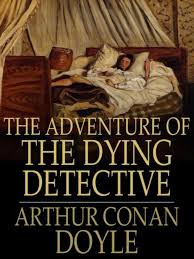
The Adventure Of The Dying Detective--In Media Res!!

It seems that the inevitable fate of many a mystery series is, well, a stultifying sameness.

As fans demand the same hero returning over and over again, the author churns out a novel (or more!) each year starring their dauntless detective. But at some point the spark seems to go out, the innovation is gone, and each story differs from the last only in the particulars of the crimes being investigated. Soon, Author E. Writer takes on a "co-writer" for the 23 novel about Detective Dick Investigator. And creativity is gone--who needs it, when every novel is guaranteed to debut on the best-seller list?

Which brings us to The Adventure of The Dying Detective.

Obviously, Sherlock Holmes stories are just that, and not novels. And surely the economics of the publishing racket of the day were a bit different.

Still, Sir Arthur Conan Doyle did have a gravy train going with Holmes, as fans eagerly awaited every word written about him. And given Doyle's famous ambivalence about his literary reputation being tied to the character, well, you have a recipe for authorial coasting. Who could have blamed Doyle if he just kept cranking out the same old same old?

But lordy, look at The Adventure Of The Dying Detective.

Sir Arthur completely breaks the Holmes formula here, giving us a completely new story structure for the Great Detective!! No, this is not another story that starts with Holmes and Watson lounging around 221B Baker Street, with Sherlock showing off in some way, until a client or the police show up asking for help.

Instead, at the outset, we're not even sure that we have a mystery! For the first time in quite a while, Doyle sets the story in the days of (one of?) Watson's marriage. And instead of a telegram from Holmes inviting Watson to join in on a new case, a third party--Mrs. Hudson!--seeks out the god doctor, as...Sherlock Holmes is dying!!

Think about how this must have seemed to contemporary readers! Once already, with no warning, Sir Arthur had killed off Sherlock Holmes. And now here he was, dying!! Without our hindsight that there were a good many tales left, readers at the time had to seriously consider the possibility that it was happening again! (Of course, in the second paragraph, Watson tells us that this story was set at least a couple of decades in the past, so readers could have grokked early on that this was a feint. But how many were that knowledgeable about the concept of continuity back then?)

Of course, there was a mystery here, and a good one. But Sir Arthur lets the information in tiny dribs and drabs, perhaps missed by the reader amidst Holmes' "delusional rantings." "His nephew, Watson--I had suspicions of foul play and I allowed him to see it. The boy died horribly. He has a grudge against me," sneaks in Holmes, between voicing serious concerns about oysters taking over the world.

And some of Holmes' behavior can certainly be seen as suspicious...but it can also easily be read as part of a mania resulting from his sickness. In retrospect, it's obvious what his game is with Watson--but the first time you read the story? The reader may be suspicious, but without the knowledge that more stories are coming? The uncertainty must have been maddening!

Starting the story in media res, and keeping the reader as uniformed as Watson, was a master stroke. It's doubtful that the story would have worked nearly as well had we started at the "beginning." For proof of that just go watch the Granada adaptation.

You have to feel pity for Granada--it's a fairly short story, and not a lot happens. As presented on the page, it would be hard to fill your 50+ minute timeslot with this tale.

So I can understand their attempt to pad out the time by actually presenting much of the background that's only alluded to in the actual story. But, to be honest, they waaaaay overdo it. It's 35 1/2 minutes into a 51 minutes show before we get to the point where the print story starts--Mrs. Hudson fetching Watson in a panic! 35 minutes!!

And, sadly, what they present, while well made, undercuts all of the tension that Doyle so masterfully presents in the original. We meet Victor Savage, who wishes to leave his job as director of the family bank to become a poet (!). Victor believes that opium will "open his senses" to improve his writing, and his cousin (not uncle, as in the original) Culverton Smith encourages that habit. Victor's wife goes to Holmes for help, but as no crime has been committed, there's not a lot he can do. Smith uses an infected mosquito (!) to dose Savage with a tropical disease as he lounges spaced-out in an opium den Smith helped him find.

(Do you sense that we're getting waaay too much detail here?)

Victor Savage has quite a lengthy getting sicker and ultimately dying sequence whilst playing children's games with his rich guests. Very lengthy. And Holmes and Watson are very certain that Smith is responsible for Savage's death, and vow both to Smith and his widow that justice will be served. Oh, yes, because of the will under which Savage inherited his house and wealth, it all reverts to his cousin Smith should he die, and we have quite the lengthy subplot with the callous Smith evicting the widow and her children and dogs. Remember, all of that was implied with one word in the original, so why not flesh it out to 8 or 9 minutes of screen time?

I'm too harsh here, as the Granada version is well made. But it completely eviscerates the tension and drama that the original provided, and indeed makes Watson seem particularly stupid. You can't have your co-star off screen for the first 35 minutes, of course, so Granada has the good doctor present for the entire case. Watson is convinced that Smith has used his expertise to kill Savage, and vows loudly and publicly to prove Smith's guilt and restore the widow to her rightful property. So when Holmes finally falls "ill" in this version, Watson has been involved with this case from the very beginning. He KNOWS who Culverton Smith is; he is convinced that Smith uses biological warfare to kill his victims; he has vowed to bring Smith to justice. So for John to believe, even for a second, that Holmes' disease is just a coincidence isn't believable. And for Watson to accede to Holmes' insistence on bringing Smith to Baker Street for treatment is simply not credible, given what the story has set up.

And, of course, the viewer is in the exact same position. By starting in media res, the written story creates doubt in our mind, and leaves us clueless as to Smith's role until much later. The Granada version, by insisting on giving us lots (and lots) of background, destroys that doubt, ruins that suspense, and makes the final reveal inevitable, instead of a surprise.

For the record, no, I don't know what I would have done if I were Granada in adapting this story.

But let's get back to the original story. 40-some stories into the Canon, Sir Arthur Conan Doyle is still experimenting with storytelling techniques, still innovating. This story comes right after The Bruce-Partington Plans, considered by many to be one of the best Holmes stories. Coming soon would be His Last Bow, which would completely break the mold in a different way.

Yes, by the time we get to Casebook, we will discuss whether or not some stories show that Doyle had entered a "contractual obligation" phase.

But right now, in the stories collected in His Last Bow, Doyle was not content to just put out the same old same old. Although not always 100% successful, his stories show that he still believed there was a lot of life left in the old detective. He was creative in theme and structure, and was still striving to tell new mystery stories in new, innovative ways. And the Dying Detective does that in spades.

OTHER TRIFLES AND OBSERVATIONS:

**The elephant in the room that everyone talks about is how cruel it was for Holmes to trick Watson this way. (Few complain that it was cruel to trick Mrs. Hudson that way, however...) They also complain about the nasty way Holmes denigrated Watson and his medical skills.

I am less down on Holmes about this than others. After all, allowing Watson to believe that he was dying for a few hours was far less cruel than allowing him to believe that you were dead for three long years.

Watson himself, despite declaring himself "bitterly hurt," took most of the rantings to be a result of Holmes' delirium, and he didn't allow it to slow his attempts to help his friend.

Holmes has deceived Watson many time, before and since, and I feel that the good doctor understands, as long as it is in the service of justice. And there is no other way the case could be cracked this time!

Declaring that Watson has no talent for "dissimulation" is, in and of itself a compliment to Watson, and Holmes apologizes most profusely (for Holmes, at least). And he goes on to praise Watson medical skills:  "Do you imagine that I have no respect for your medical talents? Could I fancy that your astute judgment would pass a dying man who, however weak, had no rise of pulse or temperature? At four yards, I could deceive you."

So, is Holmes guilty of being a jerk? Sure, but it's for a good cause, and the pain is short-lived.

**Of course, Watson probably should have sussed that something was up. Holmes' insistence that Mrs. Hudson fetch only Watson belied any later comments he made. The "dying" man's "tiger-spring" to beat Watson to the door was certainly suspicious. And Holmes demand that Watson "convey an impression" of the detective's condition to Culverton Smith, and that Watson secretly return first to Baker Street, were pretty good tips that Holmes was enacting a plan.

Still, it is to Watson's credit that he was so concerned with his friend's condition that he gave no thought to the fact that this might be another scheme of Sherlock's.

**This story does little to buttress Holmes' reputation as a detective.

We have a murder, and an attempted murder, and Holmes cannot come up with a scrap of evidence--apparently not even enough to justify a warrant!!

In fairness, forensic science and medicine were still decades away from being able to do things like run DNA profiles of bacterium and compare them, which would likely be necessary in this case to convict Smith.

Still, we are left with a situation where Holmes doesn't so much solve the case, as trick the murderer into confessing. It was a pretty large gamble--how could Holmes be so sure that Smith would come to gloat over his deathbed? "Knowing his vindictive nature, I was perfectly certain that he would come to look upon his handiwork...It was clear to me, however, that by pretending that he had really succeeded in his design I might surprise a confession."

Still, it is a large leap that, no matter how "vindictive," Smith would come to Holmes, and would actually confess.

**The story also makes one thing perfectly clear: if Culverton Smith doesn't foolishly try unnecessarily to murder Holmes, he gets away scot free. Holmes couldn't prove Smith had killed Savage, which certainly means the police had no chance. Had Smith merely shut his mouth and endured Holmes' accusations, he would have gotten away with the murder. But he let himself be goaded, and by attempting to kill Holmes, he provided the evidence--and the confession--himself. Idiot!

Even had he succeeded in killing Sherlock, it almost certainly would have made Culverton Smith more vulnerable to the police, not less so. Smith  admits that his nephew dying of an obscure tropical disease (in London--in November!) which he happened to be an expert on was a "singular coincidence." Did Smith really not understand that having his accuser die of the exact same thing would not make the coincidence theory completely untenable--particularly if there was no outbreak amongst the denizens of Rothertithe? That even the most pig-headed Scotland Yard inspector would have to act, had Holmes died as planned? Perhaps Smith was so arrogant he thought that he could still baffle the police...

**Holmes has come far from needing a roommate to afford the Baker Street flat!
On the other hand, his payments were princely. I have no doubt that the house might have been purchased at the price which Holmes paid for his rooms during the years that I was with him.
 That certainly makes it seem as if "long-suffering" Mrs. Hudson was doing quite all right for herself.

**Watson on Holmes and the ladies:"...he had a remarkable gentleness and courtesy in his dealings with women. He disliked and distrusted the sex, but he was always a chivalrous opponent."

You know, for all that's been made of Holmes' alleged antipathy towards women, we've really seen very little of it--certainly not much worth then his general antipathy towards everyone! Most of what we know of Holmes' "misogyny" comes from Watson's descriptions, not anything that Holmes himself has said. Everything we've actually heard Sherlock himself say has said is no more dire than any male who mutters "Women..." after an exasperating encounter with the mysterious opposite sex.

So, Watson, what have you been keeping from us?

**"...in the second year of my married life..."

Granada again pretends that Watson never married, and never left Baker Street, which means that have to go through unconvincing contortions (making rounds in the country?) to explain how Sherlock had been deathly ill for three days without the  doctor knowing.

**And the Academy Award for best make-up goes to..."His eyes had the brightness of fever, there was a hectic flush upon either cheek, and dark crusts clung to his lips; the thin hands upon the coverlet twitched incessantly, his voice was croaking and spasmodic."

**Say what you will about Watson, he is a selfless physician, willing to risk his own life:
"Contagious by touch, Watson--that's it, by touch. Keep your distance and all is well."
"Good heavens, Holmes! Do you suppose that such a consideration weighs with me of an instant? It would not affect me in the case of a stranger. Do you imagine it would prevent me from doing my duty to so old a friend?"
And he is also willing to swallow his ego and recommend "better" doctors, even when Holmes insults him:
But if you have no confidence in me I would not intrude my services. Let me bring Sir Jasper Meek or Penrose Fisher, or any of the best men in London. But someone you MUST have, and that is final. If you think that I am going to stand here and see you die without either helping you myself or bringing anyone else to help you, then you have mistaken your man."
This also shows that Watson, whatever the state of his practice, has been keeping up with his profession, and knows who the "best men" are. He also just "happens to know" that the greatest living authority on tropical disease is in London now. Watson is reading the papers and following his profession--how many general practitioners would have known that?!?

**Holmes tries to show Watson his "ignorance":
"Shall I demonstrate your own ignorance? What do you know, pray, of Tapanuli fever? What do you know of the black Formosa corruption?"
Much has been made of this, as commentators have tried to identify the disease Culverton Smith use to kill Savage and tried to use on Holmes from these descriptions, to match some real disease to Tapanuli fever or the black Formosa corruption.

But remember, at this point, Holmes was trying to fool Watson, and deliberately lying to him. He is trying to convince Watson that this is a case far outside his medical knowledge. Wouldn't it be just as likely that Holmes' might just make up some obscure disease names, to ensure that Watson wouldn't say, "Oh, yes, I saw a case of this when I was briefly in India!" (And if the cause of Savage's death had been mentioned in the newspapers, perhaps Watson would have familiarized himself with it, in case a case came into his practice!)

After all, the absolute best way to "prove someone's ignorance" to them is to make shit up...that way they can be guaranteed not to know!

**"I have learned so much during some recent researches which have a medico-criminal aspect."

Great. Now I want a whole season of Sherlock Quincy, Medical Examiner...

**Watson channeling Hamlet: "Of all ruins, that of a noble mind is the most deplorable."

**Inspector Morton, I hope you enjoy your cameo in the Canon!!

(Somewhat more seriously, I'm certain that Holmes went with this unknown inspector because the sight of one of Holmes' better-known police collaborators hanging about might have made Culverton Smith suspicious, had he been having Baker Street watched...)

**Doyle loves to play his villains as physically deformed, as if their evil is so vile that it must manifest in their appearance:
I saw a great yellow face, coarse-grained and greasy, with heavy, double-chin, and two sullen, menacing gray eyes which glared at me from under tufted and sandy brows. A high bald head had a small velvet smoking-cap poised coquettishly upon one side of its pink curve. The skull was of enormous capacity, and yet as I looked down I saw to my amazement that the figure of the man was small and frail, twisted in the shoulders and back like one who has suffered from rickets in his childhood.
 **The villain Smith trying to draw a parallel between himself and Sherlock Holmes: "He is an amateur of crime, as I am of disease. For him the villain, for me the microbe."

 **Smith: "There are my prisons," he continued, pointing to a row of bottles and jars which stood upon a side table. "Among those gelatine cultivations some of the very worst offenders in the world are now doing time."

Well, this wouldn't happen in 2015. A civilian household keeping a vast array of "biological weapons?" At the very least you could easily get a warrant now, based on Watson's description, and more likely you'd have Homeland Security and MI-5 and whatever all over the place in about 20 seconds.


**Holmes: "But I have reasons to suppose that this opinion would be very much more frank and valuable if he imagines that we are alone."

Yet still Watson doesn't get what's going on...

**Culverton Smith certainly has his villain smack talk down: "You can forget it or remember it, just as you like. I don't see you in the witnessbox. Quite another shaped box, my good Holmes, I assure you."

Man, we love to hate this guy. What a great villainous creation from Sir Arthur...

**Culverton Smith: "The fellow who came for me--I've forgotten his name--"

You forgot Watson's name? All right, now it's war!

**Holmes invents method acting: "The best way of successfully acting a part is to be it," said Holmes. 

**Smith thinks that Holmes really doesn't have him:
 "Now he will pretend, no doubt, that I have said anything which he may invent which will corroborate his insane suspicions. You can lie as you like, Holmes. My word is always as good as yours."
Smith obviously has a poor idea of the respect the police and courts have for Mr. Holmes' opinion, if he believes "my word is as good as yours."

**Of course, it's not down to just Holmes' word, as was the detective's plan all along.

But that begs a bit of the question: of how much value was Watson's word, in corroborating Holmes'?

After all, Watson was Holmes' former flatmate, and avowed friend. He also had a vested interest financial in Holmes' being right, given that he was writing up and publishing Holmes' adventures. A skilled defense barrister could really knock the stuffing out of any of Watson's testimony, on the grounds that he irretrievably biased in favor of the detective.

Throw in the notion that Watson was a medical man who had been thoroughly lied to and deceived by Holmes, and was unable to tell that Holmes was not ill, and the cross-examination of John Watson might not be a very pretty thing...

**I haven't designed many death-traps, but Culverton Smith's spring box seems like a very uncertain thing to me. How can you be sure that the intended victim opens it with his hands in the right position to receive the "sting?" How can you be certain that the skin is pierced, that blood is drawn? Or that your tropical disease withstands the rigors of being transported outside, during a chilly November, during a postal delivery?

The Granada adaptation used a more reasonable method---the box was full of tobacco, and sharp spikes lined the bottom, so when the victim reached in to fill his pipe, he would cut himself.

**"Malingering is a subject upon which I have sometimes thought of writing a monograph."

And it would of great use to those of us seeking to get out of work for a long weekend...

**Holmes as (justifiably) paranoid: "My correspondence, however, is, as you know, a varied one, and I am somewhat upon my guard against any packages which reach me."

I'm sure a 21st century Holmes would need radiation detectors, sniffer dogs, and who knows what else...

SHERLOCK HOLMES WILL RETURN IN--THE DISAPPEARANCE OF LADY FRANCES CARFAX

Sunday, July 5, 2015

The Adventure Of The Bruce-Partington Plans--Victorian Spy Thriller!!

The Adventure Of The Bruce-Partington plans is the third leg of an informal Sherlock Holmes trilogy.

Together with The Adventure of The Naval Treaty and The Adventure of The Second Stain, Bruce-Partington Plans tells a familiar story: a secret of vital importance to the British government is stolen. Holmes must recover it, lest the be devastating repercussions. And Holmes does succeed. They all follow the same outline.

By looking at these three stories, both the similarities and their differences, we can learn a fair amount about the state of espionage, and the quality of government security, back in the day.

First, I think it would help to have a brief recap of the stories. In The Naval Treaty, a "secret" treaty between England and Italy is stolen from the desk of a fool at the Foreign Office. The clerk promptly goes into a two month bout of "brain fever." When Holmes gets involved, he discovers that the culprit was the brother of the clerk's fiancee, who had large debts, who had stolen the document. Holmes thrashes him, and recovers the treaty.

In The Second Stain, an "imprudent" letter from a "foreign potentate" is stolen from the home of the European Minister, and seems certain to lead to war if it becomes public. Holmes discovers that it was taken by the minister's wife, who was being blackmailed by a spy over some indiscreet letters she wrote in her youth. Fortunately, the spy is murdered by his jealous wife, and the letter is recovered with nether war nor divorce.

In Bruce-Partington, top-secret plans for a new submarine are stolen, presumably by a clerk found murdered. It turns out that the brother of the department's head, who had large debts, had taken the plans and sold them to a spy. Fortunately, the spy was tricked into returning to England with the plans, and all was well that ended well (except for the poor murdered clerk!).

So what nuggets of wisdom can we tease out of these stories?

A) In all three mysteries, relatives (or soon-to-be relatives) steal the secrets. In Naval Treaty, the brother of Percy Phelps' fiance just strolls into Percy's office and takes a treaty that was sitting on top of the desk. In Second Stain, Trelawney Hope's wife is blackmailed into taking the letter for her husband's despatch box. And in Bruce-Partington, Sir James Walters' broke brother copied his keys and used them to steal England's most valuable military secret.

What can we take away from this? Family is trouble!

Or, to state it somewhat more seriously, a real weakness in any security system is when you relax your standards around the people you think that you should be able to trust the most.

In two of the stories, close family members were used by foreign agents to get access to what would otherwise be inaccessible. And in all three tales, personal weaknesses--debts and past (perceived) immoralities--led brother, brother-in-law (to be) and wife to violate family trust.

So don't be upset if you have a sensitive job and they run security checks on your loved ones. They're the ones most likely to betray you.

B) In all of the mysteries, ideology was not a motivating factor for the thefts.

This struck me as a bit surprising. Being weaned on WWII and Cold War thrillers, I've come to expect that at least some spies were true believers or fellow travelers, that they acted out of patriotism or the belief in some political/philosophical system.

But in Naval Treaty, Joseph Harrison is motivated simply by an opportunity to clear up investment debts. In Second Stain and Bruce-Partington, Lucas and Oberstein were seeking to auction off their ill-gotten secrets to the highest bidder.

Of course, international politics were different in the Victorian era, and competitions between states were less about competing ideological systems and more about national power. Still, it was surprising to see that no one in these stories was acting out of a particular antipathy for Britain or fondness for another country. It was all about the cash.

And watch out for those Stock Exchange investments. You'll lose your shirt, and have to turn to treason.

C) In all 3 mysteries, the security arrangements to protect these valuable secrets were woefully inadequate, if not criminally negligent.

In Naval Treaty, the Foreign Office has only one elderly commissionaire to watch the main entrance...and his main concern seems to be getting coffee for employees working late. Meanwhile, there is an unlocked, unguarded employees' side entrance, which leads directly to the offices and doesn't have to pass the commissionaire. Seriously--anyone can just walk in!! That has to be concerning, even if Phelps was negligent by leaving the treaty on his desktop and not locking his office door!!

In Second Stain, Trelawney Hope did not trust the governments' security, so he carried the letter with him in his locked despetch box...which he kept in an unlocked room at home, unguarded, because his family and servants were supposedly beyond suspicion.

In Bruce-Partington, Cadogan West complained that "that we were slack about such matters...that it would be easy for a traitor to get the plans." Indeed, there was only one watchman on the building--"but he has other departments to look after as well." And we learn that the shutters on the window don't even meet completely--so anyone can look into the safe room from the outside!! Granted, a thief would need to have three separate keys to pull off the crime. But once he got those, there was literally nothing left to protect England's most vital military secret!!!

Three huge secrets--each supposedly dangerous enough to lead to war--didn't have as much security as your average shopping mall shoe store!! Certainly, we can't expect advanced technology here, but how about real guards, on every entrance, 24/7?? Don't take earth-shattering documents home with you?

Given the level of government security shown in these stories, it's a wonder Britain had any secrets left to protect...

D) In two of the cases, both Holmes and the governments had lists of "known foreign spies and international agents."

Seriously, England just let these guys wander around?

I can understand the principle. It's better to have a spy you know about--so don't deport these guys immediately. Let them wander free and keep them under observation. Maybe they'll lead you to other operatives. Maybe you can use them against other governments, under the right circumstances. And if you kick them out, they'll be replaced, and you might not recognize who the new spies are until it's too late.

The problem, of course, is the all too familiar problem of departments not communicating with each other. In Bruce-Partington, Oberstein had been under some level of observation, and Mycroft's report said he had left town sometime after the plans were stolen. Well, you don't have to have a Sherlock-level intellect to figure out that when a major government secret is stolen, and the top foreign agent leaves London at the same time, there might be a connection. But no one in the government did make that connection. Three days later, apparently Oberstein's watchers still had no idea that anything untoward had happened, or that maybe they should kind of put out an urgent bulletin!

Given that level of intragovernmental cooperation, Britain would have been much better off rethinking the policy of just letting known spies wander around.

E) In two of the three stories, it was a diplomatic secret, not a military or technological one, that was stolen.

Again, this may seem a bit surprising to us--modern spy fiction is centered around stuff, gadgets and science and technology. Who goes around stealing letters from one monarch to another? Who thinks secret treaties (do they still have those?) are worth so much struggle?

A condition of our age is that those "diplomatic" secrets are leaked to the public fairly regularly--think Wikileaks, or Hillary's emails--and war never seems to be a terribly likely result. But military secrets, or intelligence methods? Now, that will get the NSA involved, and have people howling treason!!

We can certainly put some of this off to Sir Arthur Conan Doyle exaggerating for effect, or perhaps even ignorance, but the perception at the time seems to have been that diplomatic secrets were just as valuable and dangerous as military classified tech. It was believed that a poor choice of words from a potentate or word that two countries were talking was just as likely to set off a cataclysmic war as giving one side unbeatable naval superiority.

Of course, that was at least partially true, as contemporary European history was soon to prove.

F) In each of the mysteries, it was only blind luck that kept the secrets from falling into the wrong hands.

That's not to make light of Holmes' deductions and contributions. But consider that in Naval Treaty, it is only that fact that Joseph Harrison chose a particularly unlucky place to stash the treaty that kept it from being sold to a foreign power two months before Holmes became involved in the mystery. In Second Stain, if Lucas' wife doesn't choose that exact moment to show up and go into a jealous killing rage, the letter is in the hands of a foreign government before Holmes gets involved. And in Bruce-Partington, the plans have already left England!! It is only because Oberstein falls for a ruse--and brings the plans back with him to England--that disaster is averted.

In other words, having the world's greatest detective on your side is meaningless, because by the time you think to get him involved, it is already too late--unless your spies are ridiculously unlucky (and stupid).

So what can we learn through Sherlock Holmes' "spy" trilogy? Don't trust you're family. Don't invest in the stock market. Stop being so secretive and get the smartest man in the country involved more quickly. And for heaven's sake, England, if these secrets ask so damned important, invest in some decent security!!

OTHER TRIFLES AND OBSERVATIONS:

**You know, I have another suspect in this case: Sir James!!

I know, it's crazy. No, I don't seriously believe that.

But please consider this:

Sir James had access to the building and safe.
Sir James' alibi for the early part of the evening comes from his brother, Colonel Valentine, who will prove to be a very unreliable source: "Yes; his brother, Colonel Valentine Walter, has testified to his departure from Woolwich..."
We know Cadogan West saw someone he recognized in the fog that night and took off to follow him. But we never hear from his own lips whom that was, as West is inconveniently dead. It could have been James Walter, not his brother, could it not? And West's cryptic remarks to his fiancee--that security was slack, and that it would be east for a traitor to get the plans--could apply as well to Sir James as the colonel.

But Sir James died, you're probably saying. Well, perhaps. But Valentine is keen to tell us how sensitive James was about his honour. Suppose, just suppose, that Sir James felt that sting of dishonour over his brother's vast debts, which would shame the family. And Sir James decided to avoid that public shame by copying the plans and selling them. But West saw him, was killed, and that murder is the shame that killed Sir James?!?

Or, maybe he isn't dead. We never saw the body, and only have Colonel Walter's word on his death. They were in it together, and he was helping James fake his death, to escape with the profits for their endeavor. And when Valentine fell into Holmes' trap, he decided to take the heat homself to preserve his brother's name and freedom!

OK, not bloody likely.

**Still, it is legitimate to ask how Sir James did die.
 
His brother gives this explanation: "My brother, Sir James, was a man of very sensitive honour, and he could not survive such an affair. It broke his heart. He was always so proud of the efficiency of his department, and this was a crushing blow."

Oh, yes, the "he died of a broken heart!!" How very Amidala of him! (Of course, that type of death  could be interpreted as a stress-induced stroke or heart attack...)

Holmes isn't completely sold on the cause of death, either: "I wonder if the death was natural, or whether the poor old fellow killed himself! If the latter, may it be taken as some sign of self-reproach for duty neglected?"

Of course, there is a third option--Colonel Walters killed his brother, when Sir James threatened to turn him in. The traitor had no qualms at betraying his nation and destroying his brother's reputation for a mere £5,000. That hardly makes you believe that he might stop at murder to preserve himself.

When you look at it in this light, the colonels statement that, "He said nothing, but he had caught me once with his keys, and I think that he suspected. I read in his eyes that he suspected. As you know, he never held up his head again" seems much more sinister, doesn't it?

Just putting that thought out there...

**Watson is no friend of the British Travel Bureau!
[W]e saw the greasy, heavy brown swirl still drifting past us and condensing in oily drops upon the window- panes...
 Ah, that makes London sound so appetizing!!

**As the greasy, oily fog has Holmes and Watson trapped in Baker Street, Sherlock is "cross-indexing his huge book of references." Ah, to get my hands on that book!

Or, to have Sherlock able to do all that on a modern device. Holmes able to fit his entire library on an iPad?!? Someone get me a time machine...

**Sherlock's take on the sinister fog: "This great and sombre stage is set for something more worthy than [petty thefts]," said he. "It is fortunate for this community that I am not a criminal."

Oh, Sherlock, the way your mind works...

**Holmes: "It is well they don't have days of fog in the Latin countries--the countries of assassination."

Wait--does he mean Latin America? They do have fog there, right? And why are they particularly "the countries of assassination?" Some facts here, please, Sherlock!

**Hmm, a curious death, and Holmes isn't following the case in the papers? Watson has to be the keeper of this knowledge?! "There has been an inquest," said I, "and a good many fresh facts have come out. Looked at more closely, I should certainly say that it was a curious case." 

One would think that, being so bored, Holmes would at least read about local inquests, if for no other reason than to criticize the coroners' decisions. That is how he became interested in The Black Peter case before Scotland Yard came to him.

**"No ticket! Dear me, Watson, this is really very singular. According to my experience it is not possible to reach the platform of a Metropolitan train without exhibiting one's ticket."
So they don't have turnstile jumpers and free-riders in Victorian England?!?

**So, if we are to believe Holmes--that he downplayed Mycroft's role in the government in the Greek Interpreter because he didn't fully trust Watson yet--can we trust Sherlock now as to Mycroft's job? Is he exaggerating to puff up his brother? Or to have a little fun at Watson's expense?

**Watson, playing up Mycroft's prodigious size:
A moment later the tall and portly form of Mycroft Holmes was ushered into the room. Heavily built and massive, there was a suggestion of uncouth physical inertia in the figure, but above this unwieldy frame there was perched a head so masterful in its brow, so alert in its steel-gray, deep-set eyes, so firm in its lips, and so subtle in its play of expression, that after the first glance one forgot the gross body and remembered only the dominant mind.
Watson is a bit obsessed about size. "Uncouth physical inertia"? "Gross body"? "Unwieldy frame"?? Tell us what you really think, John...

**When Mycroft arrives, he is shocked that John and Sherlock haven't heard of the Bruce-Partington submarine: "I thought everyone had heard of it." A few sentences later, Mycroft describes the craft as "the most jealously guarded of all Government secrets."

In the first Annotated Sherlock Holmes, William S. Baring-Gold suggests that those two statements can't be easily reconciled. Leslie Klinger, in the second Annotated Holmes, echoes the footnote.

Poppycock!! The secret is not the submarine's existence, it's the technical details of how it works!

Compare with the modern stealth bomber. It's not a secret. Everyone has heard about it! We've seen photographs!! But the technical details of how it works? That is what is top secret.

**Mycroft declare that there are "thirty separate patents, each essential to the working of the whole..." Of course, by the time he's done with his briefing, we're down to needing only 3 of the blueprints to make the device work. If all 30 are essential, Walter and Oberstein wouldn't have limited themselves to just 3!!

(And yes, we're later told by the clerk that maybe you need 4 things, and in fact that is what draws Oberstein back to England. 4 is still a far stretch from all 30 being essential, though...)

**Mycroft the lazy:
Possibly, Sherlock. But it is a question of getting details. Give me your details, and from an armchair I will return you an excellent expert opinion. But to run here and run there, to cross-question railway guards, and lie on my face with a lens to my eye--it is not my metier.
**Holmes on the possibly of being knighted: "I play the game for the game's own sake..."

**He won't get credit for it, but Lestrade's reasoning is fairly sound:
"It seems to me perfectly clear," said Lestrade. "I have no doubt at all as to what occurred. He took the papers to sell them. He saw the agent. They could not agree as to price. He started home again, but the agent went with him. In the train the agent murdered him, took the more essential papers, and threw his body from the carriage. That would account for everything, would it not?"
"Why had he no ticket?"
"The ticket would have shown which station was nearest the agent's house. Therefore he took it from the murdered man's pocket."
"Good, Lestrade, very good," said Holmes. "Your theory holds together.
His theory turned out to be wrong, but it fit the facts they had at the time. And much better than the usual theories of the crime that Lestrade would come up with and stubbornly stick to!!

**Understatement of the Canon: "It was one of my friend's most obvious weaknesses that he was impatient with less alert intelligences than his own."

**Watson watching Holmes become alert and on the hunt:
His eager face still wore that expression of intense and high- strung energy, which showed me that some novel and suggestive circumstance had opened up a stimulating line of thought. See the foxhound with hanging ears and drooping tail as it lolls about the kennels, and compare it with the same hound as, with gleaming eyes and straining muscles, it runs upon a breast-high scent--such was the change in Holmes since the morning. He was a different man from the limp and lounging figure in the mouse- coloured dressing-gown who had prowled so restlessly only a few hours before round the fog-girt room
"Fog-girt"? Wonderful stuff, Doyle!

**Holmes is shocked that, while right on the crime, he was wrong on the criminal: "Holmes gave a whistle of surprise. 'You can write me down an ass this time, Watson," said he. "This was not the bird that I was looking for.'"

We're not told whom Holmes thought the criminal was. The only other viable suspect we meet is Sydney Johnson, the senior clerk and West's superior (unless, of course, you buy my "Sir James did it" theory above...).

Still, there is nothing in particular to make us suspect Johnson. He's only in one scene, and has very little dialogue. He says and does nothing to make us suspicious of him. There's really nothing there, at least on the page.

Obviously, given Holmes' surprise at the colonel showing up at the ambush, he must have suspected Johnson. Sir Arthur needed to do a better job of making us suspect him, as well.

**Mycroft: "The whole force of the State is at your back if you should need it."

Thus, Holmes is emboldened to bend the laws on their urgent quest:
"Could we not get a warrant and legalize it?"
"Hardly on the evidence...It's not a time to stick at trifles. Think of Mycroft's note, of the Admiralty, the Cabinet, the exalted person who waits for news. We are bound to go.
Contrast with Lestrade's disapproval of Sherlock and John's breaking and entering:
"We can't do these things in the force, Mr. Holmes," said he. "No wonder you get results that are beyond us. But some of these days you'll go too far, and you'll find yourself and your friend in trouble."
"For England, home and beauty--eh, Watson? Martyrs on the altar of our country.
That makes for a pretty good encapsulation of the arguments on whether or not legal niceties and civil rights can be set aside in a time of crisis.

In other cases, Holmes (and Watson) acknowledged the potential dire legal repercussions should they be caught in burglary, and kept the police in the dark on such activities. Here, though, Holmes openly admits to law-breaking in front of Lestrade. In this case, he is working not as a private citizen, but as a de facto agent of the state. No doubt the certainty that the whole power of the Home Office, and the Queen herself, would step in to protect him against prosecution emboldened him to speak openly in front of the police.

Score a point again for Lestrade, though, for noting that civilian status left Holmes less bound by laws and regulations than the police--"no wonder you get results that are beyond us." Meow!!

**Holmes: "I will do nothing serious without my trusted comrade and biographer at my elbow." Of course, there were plenty of times when you have done so, Sherlock...

**So, why did Oberstein leave copies of the personal ads lying about? He seemed to have destroyed all of the other evidence. Did he forget about them? Was he planning to use them and come back to blackmail Valentine later? It seems unbelievable sloppy (and lucky for Holmes).

**Holmes upbraiding the colonel: "How English gentleman could behave in such a manner is beyond my comprehension."

Oh, Sherlock, you've seen many gentleman (especially colonels!!) do this and far worse!! Has he  forgotten? Or was he just trying to shame a confession out of Walters?

**Many have questioned Watson's account that Oberstein received only a 15 year sentence for espionage and murder.

I think that the murder charge is perhaps not so certain as many think. A case can be made out for manslaughter.

Valentine tells us, "As West forced his way after us into the house Oberstein struck him on the head." The colonel is certainly not an unbiased observer. But if West were trying to force his way into Oberstein's home, you can make the argument that he was justified in his use of force. I'm no expert on the law of the day, but West is described earlier as "hot-headed," and he could be portrayed as the aggressor in this fight.

The Granada adaptation removes all doubt about it being manslaughter. Oberstein does not use a "life-preserver," and West merely falls and hits his head on the ground during a scuffle.

Of course, Oberstein may also have given all sorts of information to the government in exchange for a lighter sentence. I imagine he had a tale or two to tell...

**Oberstein "came to the lure and was safely engulfed...In his trunk were found the invaluable Bruce-Partington plans, which he had put up for auction in all the naval centres of Europe."

Why in heaven's name bring them back to England with you!?!

I can understand not wanting to leave them behind, in France or wherever. If some other spies find them, you lose your big payday.

But bringing them back into England ensures that you will be convicted if you're caught!! Surely there must have been some safe drop box you could have left them in, some unsuspected hiding place!!

**Finally, it should be noted that, despite Mycroft's histrionics, obviously naval warfare did NOT become obsolete because of Bruce-Partington submarines.

Whether the invention turned out to be a failure, or other nations developed their own versions, or military strategists devised counter-measures, all the sturm und drang turned out to be for nothing.

As Spock said, "Military secrets are the most fleeting of all."

SHERLOCK HOLMES WILL RETURN IN--THE ADVENTURE OF THE DYING DETECTIVE!!

Sunday, June 28, 2015

The Adventure Of The Red Circle--In Which I Am Hoist On My Own Petard!

I guess this is my own fault.

After all, I wrote at great length in my pieces on A Study In Scarlet and The Valley Of Fear of my disdain for the novella-length digressions in the stories. Did we really need 6 or 7 chapters of background to truly understand the background and motives of our killer and/or victims?

Which brings us to The Adventure Of The Red Circle.

Now here is a story which could have used a few more lines explaining exactly what was going on.

Don't get me wrong--Red Circle is a fine story, a good Holmes mystery. It is a story, however, where some of the answers seem to come a bit too easily, and without proper explanation.

Now, part of this is because of the story's structure. Sir Arthur Conan Doyle has Holmes drawn into the mystery because of a landlady who is creeped out by an unusual border, which leads to the much more serious case.

It's a clever conceit. But the problem is, as a result, we never meet Gennaro Lucca, and we never meet Guiseppe Gorgiano. The killer and the victim are known to Holmes and Watson only third-hand (and therefore to the reader only fourth-hand!), the story told by in patches by people who only know parts of the story. And considering that the largest parcel of background comes from Emilia, who is hardly unbiased, we get a very haphazard and distorted look at the entire story.

As a result, we're left with definite gaps in the story. The reader is left with no idea what actually happened at keys points in the tale, of how certain characters got from point A to point B.

Now, these are not "plot holes" in the sense that "Hey, this thing couldn't have happened!" Most of the questions Red Circle leaves us with can be fairly easily answered, at least potentially so, with a teeny bit of imaginative elbow-grease. But should the reader have to do so much of the heavy lifting for themselves? Especially when a couple of sentences or paragraphs, or even the use of Gennaro himself in the story, could have cleared so much up?

Amongst the more fundamental questions he have:

A) What, exactly, was Gennaro doing in London for 10 days?

Mrs. Warren states that her mysterious lodger had been there for 10 days when the story begins, and it continues the next day. That's 11 days, and we know that for ten of those, it was really Emilia in the room.

So what, exactly, was occupying Gennaro all that time?

Emilia tells us that "he wished to be free that he might communicate both with the American and with the Italian police." But we're never given an explanation of why he's communicating with them, especially the Italians.

Communicating with American police may make sense...he left them evidence against Gorgiano before he fled. He could be giving them more information. Or he could be following up on the status of their hunt for Gorgiano. He might even be working on some kind of immunity deal in exchange for testifying against the other members of the Red Circle.

But why communicate with the Italian police? Well, Gennaro was a "sworn" member of the Red Circle in Italy before he left for the United States. Perhaps he was trying to ascertain his legal status, to see if he and his wife could return. Perhaps he was also trying for immunity in exchange for evidence in his homeland.

Still, even in the pre-international telephone era, why was this taking 11 days?!? What else was he doing with his time? And why, if he was so certain the red Circle would be pursuing him, didn't he contact the British police?!?

B) How innocent was Gennaro?

When he met Emilia, she believed that he "had neither money nor position." But we know from his later confession to her that he even then a member of the Red Circle, and the "secrets of this brotherhood were frightful." Who knows what crimes Gennaro had already committed by the time he and Emilia had fled to America?

Gennaro was drawn--forced?--back into the Red Circle in America. Emilia's tale is vague, and we can't really tell how long Gennaro was a participant--days? Weeks? Months? During that time, how many "rich Italians" had fallen prey to the Circle's extortion and violence? It wasn't until Gorgiano assaulted his wife and threatened his benefactor that Gennaro decided to inform the police and flee. How many other crimes did he carry at least partial responsibility for?

And did his benefactor even survive? Emilia tells us that Gennaro "had given our benefactor full warning of this danger, and had also left such information for the police as would safeguard his life for the future."

The clear implication of this is that Castalotte survived. Yet this is only the version of events told to Emilia, by her possibly guilty husband. The Granada adaptation comes right out and says that Castalotte and his invalid partner were murdered by Gorgiano! So Gennaro's warning to the police and Castalotte failed--if it was even given.

Again, this is all very difficult to evaluate, as Sir Arthur doesn't make Gennaro present in the story for even one moment. We have nothing to judge him by except the testimony off his terrified wife--and much of that information is merely tales that she wasn't even a witness to herself!

Was Gennaro involved in the Red Circle to a much greater degree than he let his wife know? Is that the reason for the two weeks of negotiations with American and Italian police? And could it be that his killing of Gorgiano is not the self-defense Emilia would have us believe? We can never truly know...

C) Who exactly was Leverton of the Pinkerton Agency working for?

The Pinkertons, although a private detective agency, did do work for the government. Indeed, until 1893, the U.S. Department Of Justice essentially outsourced "the detection and prosecution of those guilty of violating federal law" to the Pinkertons. So, depending on when you date this story, the Pinkertons could be working for the federal government in tracking down Gennaro. And even after that date, they still could have been employed by state or local governments who lacked the resources to pursue felons fleeing to Europe.

Yet, if Leverton was fulfilling a government mission, why did he have absolutely no idea about Gennaro and his wife? Lucca (supposedly) informed the authorities of Gorgiano's operations, and currently was in contact with the American police. Why, then, did Leverton know nothing of him? For someone who "KNOWS" of fifty murders that Gorgiano is responsible for, he seems oddly uninformed about the (attempted?) murder that led the ruffian to run to England.

Of course, the Pinkertons also did lots of private work, often for large businesses. Did some of the businesses victimized by the Red Circle's protection racket hire the Pinkertons to do what the police could not--find Gorgiano and put a stop to him? Castalotte, even, if he survived?

Or perhaps Leverton was just working on his own, seeking the reward for himself...

D) How in the hell did Gorgiano find Mrs. Warren's boarding house?

Let's review our timeline. On Day 1, Gennaro and Emilia arrive in England, with a "few clear days which our start had given us" ahead of Black Gorgiano. In the evening, they make their switch--Emilia goes into the boarding house, and Gennaro never returns there.

That's how security conscious they were--Gennaro didn't even trust letters being delivered there. Emilia never left the room. They communicated through ads in the "agony" column--but there was never anything there to indicate where Emilia was.

So how did Gorgiano find her dwelling?

We can guess easily enough how they found Gennaro. Maybe some Mafia thugs just spotted him tooling around London. [PRO-TIP: when the first thing anyone describes about you is your thick black beard, you might want to shave that off if you want to be incognito.] Gennaro was also in touch with police in New York and Italy, and as this is the Mafia we're dealing with, it's certainly possible that some bent coppers passed information to Gorgiano, such as the time his cables were sent, etc.

But that doesn't explain why two Italian gentleman turned up watching the boarding house, as Gennaro wasn't there, and there was nothing to indicate that he was. He hadn't been there in days, long before Gorgiano arrived! (Or had he? Certainly he wanted to keep tabs on Emilia, so perhaps he had the bad habit of hanging around, On The Street Where You Live style, and was spotted? That would prove Gennaro considerably dimmer than Holmes supposed, as "The man cannot come near the woman, or he will guide their enemies to her.")

And if they did think that he was staying there, why did the goons wait eleven days--11!!--to try to snatch him?!? Surely, this wasn't the first time Mr. Warren left the house, was it? Why wait so long?

And then, somehow, at the end, the Red Circle figured that Gennaro was in his hidey hole in the house on Howe Street. How? Surely, even if they recognized his messages in the personal ads, they couldn't narrow down his location from "High red house with stone facings."Again, did they find him by chance and follow him? Why was all of their attention focused on this block to begin with?

In the Granada version, it was an Italian immigrant who took a special interest in helping his countrymen who sent Gennaro to that boarding boarding house. Gorgiano went to him, and tortured the information out of him. Certainly something of the kind could have happened here: they torture the man, he gives them the location, they kidnap the wrong fellow, but figure that Gennaro must be close by, and spot him going into the signal house. But Doyle gives us absolutely no indication that this is what occurred...

E) Where the hell did Gennaro go?

He warns Emilia by signal of grave danger. he is attacked by Black Gorgiano, whom he kills in self-defense. And then...he vanishes!!

You would think that his first instinct would be to head for the boarding house, to make sure that Emilia was safe. Or when he saw her in Scotland Yard custody, he would rush in, declaring her innocence, taking all the heat himself, etc.

Yet there's not a trace of him. Was he wounded in the fight, perhaps even dying somewhere hidden? Gorgiano had at least two confederates--what happened to them? Did Gennaro fall prey to them? Did he know that his killing of Gorgiano wasn't really self-defense, so he fled?

Of course, Holmes could have suggested putting ads in the Daily Gazette's agony column, or perhaps sending candle singles in cipher from Emilia's windows. But he was too eager to go to the opera.

As I said, all of these questions are fairly easily answerable. It's just that Sir Arthur didn't seem all that interested in providing us these answers. Despite Holmes' paeans to "education" and "seeking knowledge," he doesn't seem particularly interested in seeking that knowledge here. Despite saying, "and yet one would wish to tidy it up," he does absolutely no tidying. Nor does Watson seem concerned. Is Gennaro ever found? How does the trial come out? What happens to the couple? What happens to the Red Circle members still at large? The mystery may be over, but the story isn't, and the audience is frustrated by the lack of closure.

So, unlike my criticism of a couple of the Holmes novels, this is a case where I wish Sir Arthur had given us just a little bit more information to work with. Not chapters' worth--but an additional paragraph here or there could have easily addressed the concerns.

So, my bad. Sorry. I shouldn't have said that Sir Arthur needed to wrap up this type of story more quickly. Mea culpa.

OTHER TRIFLES AND OBSERVATIONS:

**Once again Holmes claims to be too busy to deal with a new client. This time, however, it really is very insulting:
"...nor do I understand why I, whose time is of some value, should interfere in the matter. I really have other things to engage me." So spoke Sherlock Holmes and turned back to the great scrapbook in which he was arranging and indexing some of his recent material.
Sorry, ma'am, your troubles aren't as important as my scrapbooking. Sheesh.

**Apocryphal case alert:  "You arranged an affair for a lodger of mine last year," she said--"Mr. Fairdale Hobbs." "Ah, yes--a simple matter."

**Mrs. Warren seems a bit high-strung to be a landlady, no?

Granted, her mysterious tenant's behavior is a bit unusual. But "I can't sleep for fright"? Really? "To hear his quick step moving here and moving there from early morning to late at night, and yet never to catch so much as a glimpse of him--it's more than I can stand"? "It's more than my nerves can stand"? "This is out of all reason"?

Yes, it did turn out to be a fairly serious matter. But at this point, it's nothing more than eccentricity, and the landlady acts as if Freddy Krueger is staying in her house!! On can only imagine how upset she would be if she had a boarder who was actually troublesome...

**You could rent a room without giving your name, or references? Those were the days, I guess. He did pay cash in advance. But just try to get a room somewhere today without a credit check and ID, and see how far you get...

**Gennaro, on the £10 he handed the landlady: "You can have the same every fortnight for a long time to come if you keep the terms."

"For a long time to come? How long, exactly, was Lucca planning on having his wife holed up there? Or was he lying, and just using the prospect of a long-term payday to entice Mrs. Warren to agree to his terms?

**Give credit to Mrs. Warren: bringing the notes, matches and cigarette stubs along with her was good thinking, and showed she had a healthy understanding of Sherlock's capabilities.

**Holmes on the doctor's facial hair: "Why, Watson, even your modest moustache would have been singed."

So Watson has a "modest" soup-strainer? Of course, a "modest" moustache by Victorian standards was likely pretty large by our standards...

**Holmes to Mrs. Warren, outlining his view on privacy:
After all, you have nothing to complain of. You have received your rent, and he is not a troublesome lodger, though he is certainly an unusual one. He pays you well, and if he chooses to lie concealed it is no direct business of yours. We have no excuse for an intrusion upon his privacy until we have some reason to think that there is a guilty reason for it.
So this is the limit to Holmes' desire to snoop: if you're not hurting anyone and not breaking a law, you can do as you will...that sounds like a lesson certain lawmakers and busybodies need to learn.

**Holmes on newspaper "agony columns":
"Dear me!" said he, turning over the pages, "what a chorus of groans, cries, and bleatings! What a rag-bag of singular happenings! But surely the most valuable hunting-ground that ever was given to a student of the unusual!...Bleat, Watson-- unmitigated bleat!
Of course, if this story took place today, there would be no shortage of ways for Gennaro to contact Emilia privately (not to mention the "lady with a black boa at Prince's Skating Club," "Jimmy," or "the lady who fainted on the Brixton bus.") Twitter, Facebook, email, Skype...not to mention just having cell phones!

But as we've discussed, "back in the day" newspaper personal columns were probably the only way to reach a mass audience cheaply and relatively clandestinely. You could try telegrams, but no doubt Gorgiano's men were watching such places.

Then again, if they found Gennaro's messages--perhaps a bit of a leap, as they would have to figure out which newspaper, and then which messages were from him--they might have posted someone to watch the newspaper offices...could that be how they found Gennaro, when he went to place his personal ads?

**Publishing the key to your cipher in the personal ad was pretty stupid. Seriously.

"The path is clearing. If I find chance signal message remember code agreed--One A, two B, and so on. You will hear soon. G."

Are we to believe that Emilia could not remember this simple children's cipher without having to tell it to the entire world? And why risk your enemies finding it?!?

**Deductive reasoning from amateurs:"
"And you connect this attack with your lodger?" 
"Well, we've lived there fifteen years and no such happenings ever came before."
Oh, Mrs. Warren, correlation does not equal causation...Still, she was right. Perhaps she would have made a fine detective, if her nerves were better...

**Much has been made of the cipher used, because the Italian alphabet, according to many, has no J and no K (not to mention no W, X or Y):

Now, Holmes did not know initially that the coded message was in Italian; he didn't figure that out after the first word was repeated three times. Therefore, the argument goes, his translation of every letter after I should have been off by two letters! T wouldn't be the twentieth letter! ATTENTA, should have been read by Holmes as AVVEPVA!

But perhaps it's not as clear cut as that. Italian, like most other languages, absorbs foreign words, and sometimes that requires adopting other letters, as well. Note this chart:
The J, K, etc, are presented as additional letters, adjuncts to the "regular" alphabet!! How else can you talk about koalas wearing jeans whilst using walkie-talkies on their yachts?

Some charts even work those letters into the Italian alphabet in our familiar English order:

I'm certainly not enough of a historical linguist to know if these letters were known, let alone accepted and integrated, to the Italian alphabet in the 1890s. But this is not as cut-and-dried example of a Doyle error as many portray it...

**Meanwhile, if Emilia's English was good enough to understand English-language personal ads, why not use English for your cipher messages conducted via candle flash? Indeed, since you're being tracked by Italians, it seems more reasonable to give your warnings in English.

**Holmes:"Ah, yes, Watson--severely practical, as usual!"

Hmm, usually Holmes chides Watson as being unpractical, and fanciful, and sentimental. One suspects that his "severely practical" here might be slightly sarcastic!!

**When Holmes has the solved the outlines of the mystery, Watson wants to know why he continues with the case:
"Why should you go further in it? What have you to gain from it?"
"What, indeed? It is art for art's sake, Watson. I suppose when you doctored you found yourself studying cases without thought of a fee?"
"For my education, Holmes."
"Education never ends, Watson. It is a series of lessons with the greatest for the last. This is an instructive case. There is neither money nor credit in it, and yet one would wish to tidy it up.
That's a nice thought, from a man who initially rejected the case because he would rather cut and paste newspaper articles!

**Gregson!!  "Journeys end with lovers' meetings." Sadly, this will be our last case with the Inspector.

**Wait, a Scotland Yard inspector AND a top Pinkerton agent are staking out the house--but they never noticed the signals? And heard no sounds from what must have been a death struggle from a room facing the street? Certainly, this was not Gregson's finest hour.

**Holmes praises Leverton as "the hero of The Long Island cave mystery."

Some have cited this as an error, as there are apparently no caves in Long Island.

This is perhaps technically true, but modern news stories tell us that "at least a half-dozen large caves within a day's drive of Long Island are open to the public." It wouldn't surprising that some caves near Long Island earned the mystery its title.

Also, there are plenty of Long Islands around besides the most famous one in New York. That include Long Island in the Bahamas, which apparently has an extensive system of caves. It's not hard to image Leverton chasing down some miscreant there.

And of course, it could just be an ironically named mystery:
Holmes: He's the hero of the Long Island Cave Mystery!
Watson: But there are no caves in Long Island!!
Holmes: Precisely! That is the mystery!!
**Gregson, it turns out, would have made a fine rule-breaking American detective:
Leverton:"What do you suggest, Mr. Holmes?"
Holmes: "That we go up at once and see for ourselves."
Leverton: "But we have no warrant for his arrest."
Gregson: "He is in unoccupied premises under suspicious circumstances," said Gregson. "That is good enough for the moment. When we have him by the heels we can see if New York can't help us to keep him. I'll take the responsibility of arresting him now."
Ah, the equivalent of pulling over someone suspicious looking for a broken tail light!

Gregson would fit right in on an episode of (American) Law & Order!

**Watson, on the virtues of the English police:
Our official detectives may blunder in the matter of intelligence, but never in that of courage. Gregson climbed the stair to arrest this desperate murderer with the same absolutely quiet and businesslike bearing with which he would have ascended the official staircase of Scotland Yard. The Pinkerton man had tried to push past him, but Gregson had firmly elbowed him back. London dangers were the privilege of the London force.
Scotland Yard: dumb but brave!! Sheesh, no matter so many felt ill at ease working with Sherlock--Watson did a great job by himself of publicly disparaging them!

**Emilia, upon seeing Gorgiano's bloody body:
Then I heard a sudden sharp intake of her breath, and she sprang into the air with a cry of joy. Round and round the room she danced, her hands clapping, her dark eyes gleaming with delighted wonder, and a thousand pretty Italian exclamations pouring from her lips. It was terrible and amazing to see such a woman so convulsed with joy at such a sight.
Terrible and amazing is right, doctor.

Not the the sudden relief from months of terror won't make you do funny things...but really, this is kind of behavior that makes you and your husband look guilty in the eyes of the police!

**Emilia: "But once as I looked through my window, I saw two Italians watching the house, and I understood that in some way Gorgiano had found our retreat."

So, how did she know they were Italian? Some style of dress or hair that only Italians wore, and no one else in England?

**Once again, foreign quarrels settled on British soil. It's well past motif, and even beyond cliche at this point.

I mean, c'mon, can't British citizens commit crime against other British citizens anymore? Or perhaps all of the stories are representative (perhaps subconsciously) of an English xenophobia of the era--"all foreigners are trouble!"

**This is the most closure we get from this story:
"I don't know what your British point of view may be, but I guess that in New York this lady's husband will receive a pretty general vote of thanks." "She will have to come with me and see the chief," Gregson answered. "If what she says is corroborated, I do not think she or her husband has much to fear.
At least The Valley Of Fear gave us a sentence telling us the outcome of the self-defense trial. C'mon, Sir Arthur, don't leave us hanging for over a century!!

**Holmes: "By the way, it is not eight o'clock, and a Wagner night at Covent Garden! If we hurry, we might be in time for the second act."

Or, you could find Gennaro, find the other Red Circle members, and actually finish the case...

SHERLOCK HOLMES WILL RETURN IN--THE ADVENTURE OF THE BRUCE-PARTINGTON PLANS!!