Sunday, April 19, 2015

The Adventure Of The Golden Pince-Nez--How NOT To Adapt A Holmes Story!!

I have nothing but sympathy for those trying to adapt stories from one medium to another. There are a near-infinite number of choices that must be made-what to include, what to discard, what to expand upon, what to elide past, how to stretch or squeeze to fit the available time slot. It's a thankless, difficult task, and adapters rarely get enough credit.

Adaptation can be especially tricky when it comes to Sherlock Holmes stories. 80% of the tales, it seems, begin with Holmes or Watson sitting around Baker Street, when a client or policeman comes in to make a huge exposition dump. Not necessarily the most engaging thing to put on film, so adapters have to be clever to avoid the first third of their show merely being talking heads. There's also the problem of Watson being a humble narrator--many of the written adventures have him being nearly silent, with all of the best lines going to Holmes. Making Watson an actual character in an adaptation requires a bit of work. Add in the fact that some of Sir Arthur Conan Doyle's short stories do not seem to have enough content to fill 50+ minutes, and you'll see that adapting the Canon is usually much more involved than "just filming the story."

That being said, there are a number of missteps that can clear be labeled missteps, clear mistakes that detract from the adaptation and make it far weaker than the original story. Which brings us to The Adventure Of The Golden Pince-Nez.
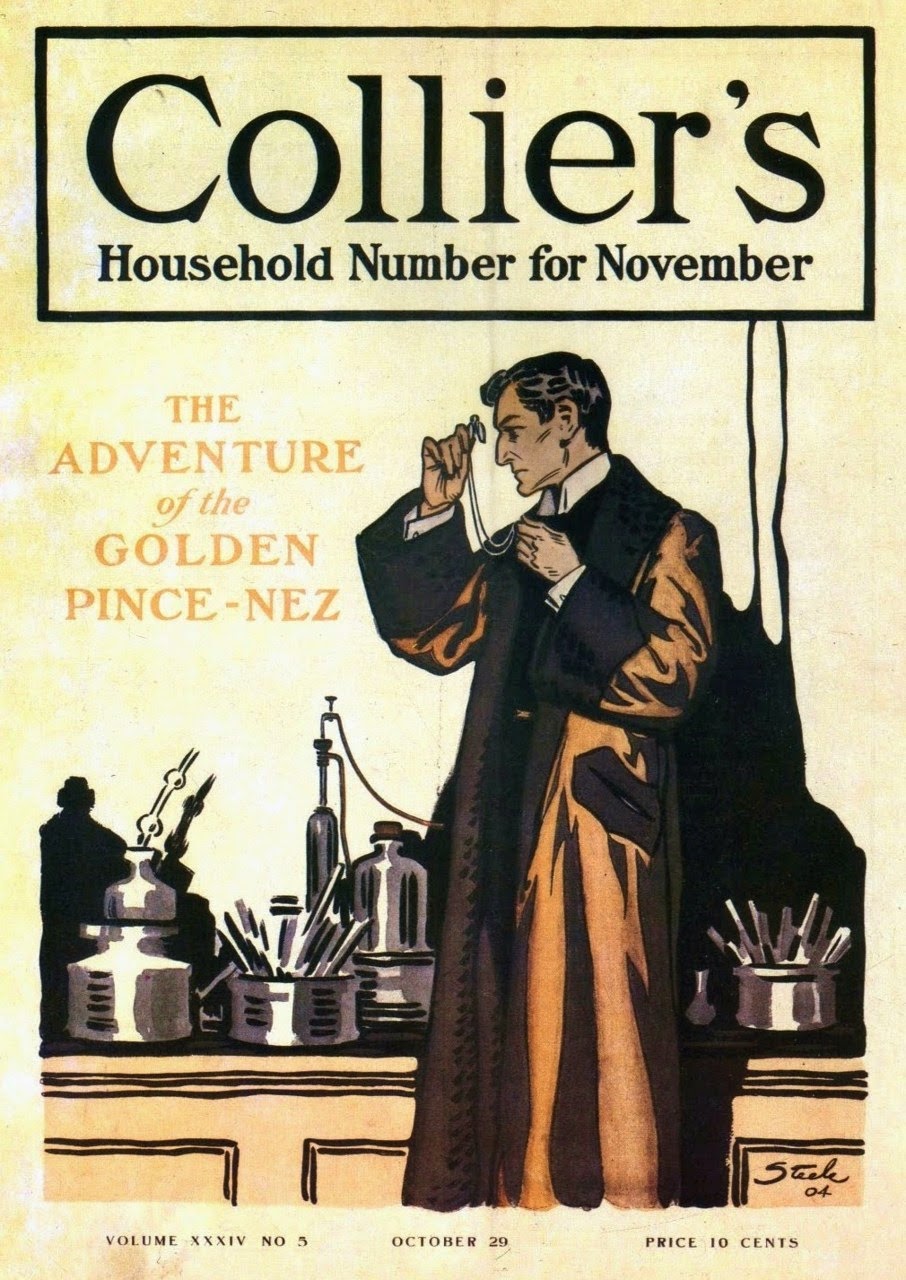
The Granada adaptations, by and large, do an excellent job of translating the Canon to the small screen. But--as is almost inevitable in doing so many stories--sometimes they make choices that are baffling, that seem (to me) to actually hurt the story they're trying to portray. And in Golden Pince-Nez, they seem to make every bad choice possible, turning what is a nice little Holmes mystery into a sloppy show that diminishes the detective and takes away the most intriguing part of the mysteries.

Granada starts with an odd cold open. Now, it is not unusual for them to have taken the murder or burglary from a story, and show that as the opening scene. That's usually defensible--it makes a gripping, interesting way to bring the viewer into the story, and breaks up the potential monotony of talking heads merely dumping exposition about the crime at Baker Street.

But in this case, Granada makes an awful decision. They choose to start with a scene of tsarist police bloodily breaking up a protest in Russia, and show Anna being arrested, and show a close-up of her glasses.

Why they do this is inexplicable, at least to me. The fact that this story is (once again) the result of foreign intrigues come London is kept hidden from the reader until the very end of the story. When Anna declares, "He is not an Englishman. He is a Russian," the reader is surprised. The viewer is not, because they have already been told that the story involves Russians, and no one else in the story can credibly be Russian. Why spoil the big reveal with the opening Russia scene?

Furthermore, by focusing on Anna and her glasses in that opening, Granada has sort of spoiled the mystery. No matter how many red herring suspects with pince-nez glasses they trot out, they've already told the viewer that the mystery must revolve around this woman, and a Russian connection!

The next problem is not entirely Granada's fault. Edward Hardwicke was unavailable to play Watson for this episode. Well, of course Sherlock needs someone to talk to, so they chose to have Charles Gray reprise his role as Mycroft for the story.

In and of itself, that is a practical and wise decision. And they do add a nice bit where Sherlock and Mycroft play "dueling deductions" over the pince-nez. However, for reasons that I once again do not understand, they decide to have Mycroft steal Sherlock's thunder in the episode, and have him solve the mystery!

In the original story, Holmes has already deduced that the killer must be concealed behind one of the bookcases. So he smokes "cigarette after cigarette"--a "great number," in his own description--and sprinkled the ash all over the floor. Why? So that when Anna came out during his absence, Holmes could tell from the disturbed ashes exactly where her hiding place was.

But in the Granada version, Sherlock does not know where Anna is hiding. He smokes one cigarette, as a courteous guest. Mycroft makes the deduction, and he surreptitiously spreads his snuff all over the floor. Later, he hands Sherlock his empty snuff case, telling his brother that he might find it useful--and it is only later that Sherlock realizes what Mycroft has done, and what it means! While Mycroft is the smarter brother, surely we're not tuning in to watch him solve crimes instead of his brother!

Another problem the Granada production has is to tar the character of Willoughby Smith for the purpose of providing a string of red herrings.

We're told from the first that the vexing part of the case for Inspector Hopkins is that there was "no motive...no reason on Earth why anyone should wish him harm." His investigation of Smith's background show that the young man "had nothing against him" with "no weak spot in him at all."

This isn't some minor point. Given the limited availability of physical forensics available in the day, "motiveless" crimes could be very difficult for the police to solve. In terms of the fiction, this is why they needed Holmes to come help them. And it's the basis of the beginning of Holmes' deductive chain--the lack of motive, along with the choice of weapon, told him that the murder was not planned, and that Smith was an innocent bystander in the wrong place at the wrong time.

Granada, however, decided that they had to throw lots of red herrings out there, to make us believe that there was motive to murder Willoughby Smith. First, they tell us that he was pitching woo and pledging eternal love to the young maid, Susan. Not only that, but he was cheating on her. He was making time with, and actual proposed to, local suffragette leader Abagail Crosby (who was created out of whole cloth for the adaptation). Susan witnessed this, supposedly giving her motive to murder Smith. And we also see Smith being disdainful of the suffrage cause, and striking Abagail when she refused to stop her activities. So now she had a motive to murder him. And Crosby had a pair of pince-nez!!

We get to waste a great deal of time in the Granada version with Hopkins having to interview these two ladies, trying to get them to admit they committed the murder. This is foolish on two levels. First of all, because they opened the story in Russia, the audience knows that the killing and the glasses had to have something to do with foreign intrigue. So we know that these people had nothing to do with the killing--you've already told us that!!

Secondly, this makes Inspector Hopkins' earlier investigations look shockingly incompetent. After declaring that there was not any possible motive, and not a single possible spot against Smith, who "knew nobody in the neighbourhood" and "existed only for the work,", the production tells us Smith was actually a two-timing woman-beater (who hates suffrage, to boot!). How could Hopkins have possibly missed all of that? By changing Smith's character so radically, this adaptation undermines any faith we might have had in Hopkins as a student of Holmes' methods!

Granada also changes Professor Coram's motivations, once again bafflingly, and not for the better. In Russia, he and Anna were "reformers--revoluntionists--Nihilists!" When a police officer was killed, he turned on his comrades, confessing to save himself and get a great reward.

But there was another reason--Anna had a boyfriend in the Order. Anna describes Alexis as "the friend of my heart. He was noble, unselfish, loving--all that my husband was not." I think we can take that as Victorian code for having an affair of the heart, at the very least. And the implication seems clear that jealously of the older husband for the relationship between his much younger wife and her work buddy that caused him to hide exculpatory evidence and "tr[y] hard to swear away the young man's life." That makes sense--he wanted Alexis imprisoned or killed as retaliation for whatever was going on between the non-violent revolutionary and his wife.

So it is truly odd that Granada changes Alexis from "the friend of Anna's heart"...to her brother! Well, that removes the jealousy motive (unless we're implying that something pretty icky was going on, at least in Sergius' mind). So, why, exactly, would he lie and conceal evidence to keep Alexis unjustly in jail? Did Coram bear a grudge against Alexis for some reason? We get absolutely zero explanation--Anna's exposition is essentially the same in the adaptation as in the novel--except that Alexis is now her brother, and Sergius stole the diary and letters for no particular reason.

Finally, and not of such great consequence: in the adaptation, a member of the Brotherhood comes in through the skylight and slays Coram in the very last scene! In the story, he survives, as far as we know. Anna had promised not to betray his secret, and there is no indication that Holmes or Hopkins did so. Yet in the Granada version, an extremely scruffy Nihilist is seen spying on the professor throughout the story. Did Anna tell them, despite her promise? Had they been following her during her search for her husband? Certainly, it's not too significant a change, but it does serve to weaken Anna's character. Now, we must conclude that either she was a liar, or so foolish that she didn't realize she she was indeed sentencing Sergius to death. She is stripped of some of her agency, and her nobility that made her so appealing next to the craven professor.

So what do we have? Several small amendments to the story, which in a mere listing may not seem much. But upon closer examination, and taken cumulatively, they seriously weaken the tale. The surprise reveal of the mystery is ruined. Sherlock is made to look an inferior detective. The mystery of a motiveless crime is eliminated by trying desperately to create red herrings, and in the process turning Willoughby Smith into a monstrous cad. Coram loses his motive to keep Alexis imprisoned. And Anna is made to look weaker by her inability to keep her pledge not to betray Coram.

As I said above, adaptation is hard, and I don't expect one to adhere slavishly to the original. But in almost every unnecessary decision they made this time, director Peter Hammond and screenwriter Gary Hopkins decided poorly, and as a result, they did little justice to The Adventure of The Golden Pince-Nez.

OTHER TRIFLES AND OBSERVATIONS:

**Kvetching about the Granada version aside, this is a pretty good tale.

Sure, with over a century of mystery hindsight, the "victim wasn't really the target" may seem a little trite today. But at the time it was a pretty good gimmick.

Holmes is in top form, not allowing himself to be distracted by false theories and irrelevancies, and seeing what should have been obvious to Hopkins very quickly.

And of course, there's all the smoking...

**Admit it--when you first saw the title of this story, you had absolutely no idea of what a pince-nez was, let alone a golden one. I admit my ignorance...

**Watson tell us of "three massive manuscript volumes which contain our work for 1894." Three massive volumes!! And you've given us only a dribble, Doctor! Get writing!!

**This story is the mother lode for those fascinated by references to apocryphal stories:
I see my notes upon the repulsive story of the red leech and the terrible death of Crosby, the banker. Here also I find an account of the Addleton tragedy, and the singular contents of the ancient British barrow. The famous Smith-Mortimer succession case comes also within this period, and so does the tracking and arrest of Huret, the Boulevard assassin--an exploit which won for Holmes an autograph letter of thanks from the French President and the Order of the Legion of Honour.
We've seen several other references of cases that Holmes has done for the French government in this period...did they have him on retainer?

**Watson (& Doyle!) waxing poetic about the weather:
It was strange there, in the very depths of the town, with ten miles of man's handiwork on every side of us, to feel the iron grip of Nature, and to be conscious that to the huge elemental forces all London was no more than the molehills that dot the fields.
Sir Arthur never gets enough credit for Watson's descriptive narration, and the wonderful turns of phrase used so often.

**A slam on journalism, as Hopkins disdains the paper's coverage: "Well, it was only a paragraph, and all wrong at that, so you have not missed anything."

Given what we know of the case, how much could they have gotten wrong? Did they name the wrong victim? The wrong address? Did they spell Hopkins' name wrong, so he's in a snit?

**Hopkins describing who lives at Yoxley Old Place: "was taken by an elderly man, who gave the name of Professor Coram."

Well, that's an odd turn of phrase. You usually wouldn't say "this person gave his name as X" unless you were already suspicious that that wasn't his real name, would you? If someone asked you who lived at 221B Baker Street, you probably wouldn't say, "Well, he gave the name of Sherlock Holmes."

Did Hopkins already suspect that Coram was an assumed identity? Nothing else in the story would suggest that. Was that phraseology more common back in 1894? Or did Doyle accidentally tip off the story's twist?

**"At first the maid thought that young Smith was already dead, but on pouring some water from the carafe over his forehead..."

Was that standard first aid procedure in the day? To pour water on the face? Not checking for a heartbeat, staunching the bleeding, elevating the wound? Nope--throw water on their forehead!

And if she thought Smith was dead, why was she pouring water on his face, anyway? An emergency baptism?!?

**Honest confession--when I first read the story, I was certain that Professor Coram was faking being an invalid. And he sometimes went out dressed as a woman. That would explain Smith's dying words: "The professor,' he murmured--'it was she.'" It would also explain how the killer "got away"--it was the professor, and he just went back into his room.

Yeah, I was wrong. But you have to admit, it was a fairly cool theory...

**Holmes continues to poke at Hopkins' competence fairly mercilessly: "What did you do, Hopkins, after you had made certain that you had made certain of nothing?"

Perhaps that is actually a sign of Holmes regard for Hopkins potential--he holds the young man to a higher standard...

**Then again, perhaps Hopkins IS a terrible detective:
There were some papers of importance in the cupboard, but there were no signs that this had been tampered with
But there had obviously been some tampering--the scratch on the metal was fresh, and the flecks of varnish were still present, which means the scratch had to have happened after the last time the maid dusted--just a quarter hour before the murder! How could Hopkins have missed this?!?

Really, if Hopkins truly considered himself a student of Holmes' methods, then based on this outing, he's not going to get a very good grade.

**Holmes description of Anna, based merely on her glasses:
Wanted, a woman of good address, attired like a lady. She has a remarkably thick nose, with eyes which are set close upon either side of it. She has a puckered forehead, a peering expression, and probably rounded shoulders. There are indications that she has had recourse to an optician at least twice during the last few months. As her glasses are of remarkable strength, and as opticians are not very numerous, there should be no difficulty in tracing her.
As many have pointed out, just because the glasses are relatively expensive, it does not automatically translate that the owner is currently well-to-do. Especially given the evidence that the owner had gone to the trouble to repair them (twice) rather than replace them. Compare, for example, the case of Henry Baker and his precious hat in Blue Carbuncle...

**Holmes again instantly seeing what others should have seen long before he became involved: "The idea of murder was not in her mind, or she would have provided herself with some sort of weapon, instead of having to pick this knife off the writing-table."

**Watson's description of Coram:
I have seldom seen a more remarkable-looking person. It was a gaunt, aquiline face which was turned towards us, with piercing dark eyes, which lurked in deep hollows under overhung and tufted brows. His hair and beard were white, save that the latter was curiously stained with yellow around his mouth. A cigarette glowed amid the tangle of white hair, and the air of the room was fetid with stale tobacco smoke.
Watson almost makes him out to be Gandalf: "He was, indeed, a weird figure as he turned his white mane and his glowing eyes towards us."

**Watson says that Coram had "a curious little mincing accent."Obviously he was trying to hide his native Russian accent.

It should be noted that "mincing accent" was a fairly common usage at the time, usually referring to the perceived "sing-song" accents of East Indians and other Asians attempting to speak the Queen's English. Some speech books of the day also referred to Cockneys has having a "mincing accent."

**So, Professor Coram smokes. A lot. An awful lot:
He sends me a thousand at a time, and I grieve to say that I have to arrange for a fresh supply every fortnight.
If we take that as literally true, that equates to more than 70 cigarettes per day!! If he sleeps 8 hours a day, that's more than 4 cigarettes per hour, all day long!

Even if we allow for casual conversational rounding, and perhaps self-deprecating exaggeration, that's still one hell of a lot of cigarettes. And they're all unfiltered!!

**The smoking, of course, allowed Holmes' ploy with the ashes:
I observed that he was smoking with extraordinary rapidity. "I am a connoisseur," said he, taking another cigarette from the box--his fourth--and lighting it from the stub of that which he had finished consuming cigarette after cigarette.
Here's the thing, though--were there no ashtrays in those days? I mean, even if he's your guest, wouldn't you notice/mention that a guy is just dumping the ash from a dozen cigarettes all over your carpet?

Or was that the accepted practice in the household? The maids must have a lot of fun cleaning the place...

**Corams description of his maid: "Susan is a country girl," said he, "and you know the incredible stupidity of that class."

Of course, Coram is trying to get the detectives to ignore the girl's evidence, so he has ample motive to try and get them to discount what she heard.

Still, it's amazingly rude. I guess reformed Nihilists can still be obnoxious class snobs...

**Wonderful observation/deduction by Holmes: "Ah! But it kills the appetite." And yet he ate all of his meals...

**Tipping the cigarette case is an old ploy that Holmes has used as a distraction many time before. Tipping over the vase in the Reigate Squires is another example...

**Watson on Anna 's first appearance:
 Her face, too, was streaked with grime, and at the best she could never have been handsome, for she had the exact physical characteristics which Holmes had divined, with, in addition, a long and obstinate chin. And yet, in spite of all these disadvantages, there was a certain nobility in the woman's bearing--a gallantry in the defiant chin and in the upraised head, which compelled something of respect and admiration.
Yet Watson doesn't do very well as a doctor here. Despite obvious signs that she's under some fairly serious distress, it is Sherlock, not John, who notices something is amiss: "I fear that you are far from well." 

Even when she "had turned a dreadful colour, the more ghastly under the dark dust-streaks upon her face," Watson doesn't seem able to perceive that something is seriously wrong, let alone attempt to diagnose her malady.

**Once again, foreign intrigues have come to London to settle matters in a deadly fashion. Seriously, why the hell did Britain ever allow immigrants in, given all the trouble they cause in the Canon?

**OK, here's the big problem with our mystery.

The sequence of events: Anna sneaks into the house and steals the letters & diary. Willoughby Smith stumbles in while she's doing it, and she accidentally kills him trying to escape. She accidentally flees down the wrong corridor, and end's up in the professor's room. She threatens him--"hide me or I'll tell the Brotherhood where you are." He complies, going to great length to hide her.

But couldn't Anna have cut out all those middle steps? Rather than the break in and the struggle and the hurried misguided flight, couldn't she have just openly gone to the professor to begin with, and said "give me the letters or I'll tell the Brotherhood where you are"? We've already seen that he was terrified of that outcome, and gave in to that threat even when it meant concealing a murderer. Wouldn't he have given in just as quickly if she had called on him during business hours, and made the same threat? No burglary or murder needed!!

Sure, she thought, "Yet I was sure that, with his revengeful nature, he would never give it to me of his own free-will." But he did give in to you, because of a simple extortion. Why wouldn't he have done the same initially?!?

**The second failed secretary being a private detective hired by Anna is rather a delicious detail, don't you think? It's too bad Doyle passed up on the opportunity to have Holmes comment on the quality/foibles of the contemporary "private detectives."

Still, we must ask, as he was already in the household, and had already made an impression of the key, why did the gumshoe decide that "he would not go further"?? Fear of breaking the law? He had already obtained for her an impression of the key and a floor plan and a diary of the household's movements, in full knowledge of what Anna intended to do with them. This private detective is surely guilty of being an accessory to the burglary. So why cop out before the actual theft?

Anna should have gone to Holmes instead of a private firm. He likely would have been sympathetic to her cause, and we've seen that he has fewer qualms about bending the law when he perceives that justice is at stake...

**Anna has, I think, a remarkably naive view of how the Russian government would react to these papers:
He wrote forever dissuading us from such a course. These letters would have saved him. So would my diary, in which, from day to day, I had entered both my feelings towards him and the view which each of us had taken.
Does anyone believe they would have commuted Alexis' sentence with this information? "Oh, he was a Nihilist who wanted to overthrow the Tsar, but he opposed violence--he wanted to bring down the royal family with peaceful means! We have no problem with that kind of free political expression! Let him go!"

I'm just saying, oppressive regimes usually aren't so reasonable when it comes to releasing dissidents.

Also, isn't it possible that those papers could end up implicating others who were involved in the Brotherhood but hadn't been caught? Just giving them to the Russians, without some serious study and perhaps editing, might not be wise.

Watson doesn't tell us the outcome of giving the letters and diary to the Russian embassy. But I'll wager that it wasn't a good outcome.

**Why did Anna bring poison?

I understand why she killed herself when she did--she didn't want to face the gallows or another long prison term.

But did she plan on getting caught?

There have been a couple of radio adaptations of the story, and in those she either shot herself or threw herself in front of a train. Obviously, just as not bringing a weapon showed she didn't intend to be an assassin, in those versions not bringing the poison showed she hadn't planned on dying.

We have to wonder--did she plan to poison Sergius? Poisoning his precious cigarettes, for example?


SHERLOCK HOLMES WILL RETURN IN--THE ADVENTURE OF THE MISSING THREE QUARTER!!

Sunday, April 5, 2015

The Adventure of The Three Students--The Adventure Nobody Cares About

There is something to be said for virtually every Sherlock Holmes story. Some interesting tidbit, some wonderful character, some clever bit of deduction, some keen observation on the cultural and societal forces of Victorian/Edwardian England, some unique bit of information and characterization for Holmes or Watson, some delicious dialogue. Almost every story in the Canon, even if not 100% successful, gives the reader (and blogger!) something to attach to.

And then there's The Adventure of The Three Students.

I don't mean to be harsh, as Three Students certainly isn't a bad story. And, since each and every Holmes story seems to be somebody's favorite, I'm sure the tale has ardent defenders who will tell you that it is their favorite. And more power to them--IDIC and all that.

Yet I find Three Students incredibly hard to connect with. And I think most people agree with me. Three Students is one of the few Holmes tales which has never seen a screen adaptation (at least none that I can find reference to). Approximately 90% of the discussion by commentators centers around trying to discover whether the university it takes place at is Cambridge or Oxford. The rest is devoted to discussing whether the mystery is really an elaborate hoax that Soames (and Watson?) are playing on Sherlock, or how preposterous and unlikely the events of the story are. Very few, it seem, like Three Students as a story.

Why is this story so, well, meh? First and foremost, to me at least, are the titular 3 academics. In a story titled the Adventure Of The Three Students, we never meet two of them, and the third doesn't get so much as a line of dialogue until the last two pages of the tale. To be clear: Miles McLaren is never seen--his "rude" voice is only hears through a door--and he never interacts with Holmes and Watson. After he is first mentioned by Soames, he's never even referred to by name again in the story!

The Indian student, Daulat Ras, also has no dialogue the entire story, and no interaction with our heroes, save Watson's mention after the fact that Ras "looked at them queerly."

And finally, there is Gilchrist--who is never even given a first name! Again, while we're told of him, we don't meet him until near the end, and even then we get nothing but accusing looks and a "storm of passionate sobbing." It isn't until after Holmes recounts his version of events that young Gilchrist utters a single word.

So when your story is titled The Adventure of The Three Students, and the three of them are but the flimsiest rough drafts of sketches of actual characters, your story is probably going to lack a little bit of oomph. When the reader doesn't meet any of the three students, it's very hard to work up some level of caring about which one might be guilty.

Now, that's not necessarily a crippling defect. In our last story, The Six Napoleons, we don't meet Beppo, he has no last name, and doesn't utter a single line of dialogue. But Six Napoleons has something that Three Students lacks--Sir Arthur Conan Doyle doesn't make this much of a mystery, really. So little does he seem to care about the other students, that he doesn't really bother to try and make them serious red herrings. Every bit of evidence points to Gilchrist, and Holmes seemingly has the case solved about 5 minutes in. Anything that doesn't point to Gilchrist, Holmes dismisses instantly. Absent some surprise twist--which this story doesn't have--there really is no other way it could end than for Gilchrist to have been the culprit.

And the story lacks either the stunning twist--the murder victim is actually alive, framing someone!--or the outre and intriguing set-up of the mystery itself--why is someone smashing busts?--that can make even milder mysteries much more entertaining. The entire plot follows a very straight and narrow outline: somebody peeked at the exam questions. It has to be one of these three people. Look it's the one whom all the evidence pointed to! It's such a straightforward mystery--no surprises or reversals along the way--that the denouement is lacking the energy of a typical Holmesian resolution.

Another thing the story lack are serious stakes of any kind. Now, we don't need to have murder--or even an actual crime of any kind--to make for a good mystery. But even in Sherlock Holmes stories without real crimes, there is some semblance of high stakes, of consequences to someone we've met. Who is the missing fiancee? Can a marriage survive some unknown deceit? But there is nothing of that kind of import here. A student cheated. If the truth comes out publicly, there will be a huge scandal. But since we never meet the students, it's hard to care how a controversy might effect them. Might Soames or Bannister be fired for incompetence? The issue is never brought up, and again, it seems hard to work up much sympathy. Why should we care if this "hideous scandal throws a cloud" on the university? (Part of that, it must be said, is due to Watson's discretion. By so diligently covering up the identity of the school, he blunts our ability to care about the results)

We might have more empathy for the low-stakes scandal, but Doyle fails to give us entertaining characters who might be hurt. Again, the contrast with Six Napoleons is pretty stark. That story was filled with interesting characters--the journalist more concerned with getting a story than the murder on his doorstep, the shop keeper who saw anarchists everywhere, the doctor who was a Bonapatre-o-phile...not to mention Lestrade. Three students, however? We've already discussed how the titular characters have no characterization. The only other players on our stage are Soames, the tutor, and Bannister, the butler. Neither one does or says anything that makes them interesting, or even different on some level from the same archetypes in any other mystery story: the nervous school official and the loyal butler.

As for Sherlock himself, he seems grumpy and mean. He goes out of his way to insult Watson on more than one occasion, as well as Soames. He's short and dismissive with any suggestion that doesn't lead to Gilchrist--and why not? He solved the mystery five minutes in! And given that Holmes himself dismissed the possibility of someone just walking into the room when the proofs were there as "an unthinkable coincidence," it seems a poor show indeed that his solution relies just as much on an even more unlikely set of coincidences--that someone tall enough would happen to wander by and look in the window while the proofs were there at exactly the same time the key had been left in the door. Not so unthinkable a coincidence when it's your solution, eh, Sherlock? And let's not forget the even still more unlikely coincidence that Bannister had been Gilchrist's father's butler, and ended up being a butler in the exact same building that Gilchrist stayed in while at university! Heavens!

And Holmes displays no great feats of deduction in Three Students. He is given straight clues with only one interpretation. There is no drama or surprise in his surmises, except perhaps for the pencil--but that proves to be a complete dead end, of no relevance in solving the case.

And once again, speaking of solving the case, Sherlock is utterly irrelevant to the tale's outcome. Had he not been summoned by Soames, Gilchrist had still been counseled by Bannister, had still written his letter confessing, and had already taken the job with the Rhodesian police. Had Holmes never become involved in the mystery, than the outcome would have been exactly the same! That, as I've remarked in the past, is never the sign of a good Holmes mystery.

I shouldn't be too harsh. Three Students is by no means a bad story. But it is so by the numbers, so lacking in the depths of characterization and period and details that make other Doyle stories so appealing, that it seems tepid and lifeless compared to other stories in the Canon. Which is why it is the story so few seem to care about.

OTHER TRIFLES AND OBSERVATIONS:

**As I mentioned above, tons and tons (and tons) of commentary and argumentation has been dedicated to the question as to which university this story took place at, and whether that gives us any clues as to which of the schools Holmes attended.

I'm absolutely agnostic on the matter--I neither know nor care. It's not just that I'm not at all familiar with Cambridge or Oxford. If there story were set in America, I don't know that it would make a whit of difference if it were set at Harvard or Yale. I just don't think that, for the most part, knowing where someone went to college necessarily tells you that much about their character. (I am perfectly willing to admit that they may have been prevailing attitudes in Victorian England about what unique attributes a person who matriculated at each school might have. Then again, that was surely a stereotype at best, and a useless cliche at worst.)

Well, few agree with me, obviously, as many folks have spent forests worth of pages debating which school the three students attend. The funny part is, they do this despite the fact that Watson quite explicitly says that he's going to disguise all of the details so that the reader cannot possibly tell:
 It will be obvious that any details which would help the reader exactly to identify the college or the criminal would be injudicious and offensive. So painful a scandal may well be allowed to die out. With due discretion the incident itself may, however, be described, since it serves to illustrate some of those qualities for which my friend was remarkable. I will endeavour, in my statement, to avoid such terms as would serve to limit the events to any particular place, or give a clue as to the people concerned.
Yet every commentator decides that either Watson is a liar, or incompetent, because they proceed to ignore his admonition, and dissect every detail as if the doctor wasn't actually trying to disguise things.

Indeed, at the end of that very first paragraph, William S. Baring-Gould, in the first Annotated Sherlock Holmes, gives us a footnote suggesting that Watson has already given up the game, because Oxford at the time was a city, while Cambridge was only a town.

In other words, one of the greatest Holmes scholars decided that Watson, despite his promise to disguise things, didn't even make it through the very first sentence of his story without failing in his purpose.

Hogwash.

**One interesting point, both from Watson and the panicked Soames, is the supposition that the revelation that a student tried to cheat damage over the entire school. "There will ensue a hideous scandal, which will throw a cloud not only on the college, but on the university," says Soames.

That is an odd supposition. Why would the university be found at fault because a student tried to cheat? Was it their fault for admitting a young person who proved later to have questionable ethics? If the scandal became public, would the populace of England say, "Oxbridge admitted a cheater! The rogues! I'll never send my sons there!"

Certainly, there have been cases where colleges have helped students to cheat, usually in order to maintain some athletic eligibility. But this isn't that type of scandal. Why should the university itself experience any disapprobation in this case? (Unless, of course, you wanted to blame them for Soames' and Bannister's incompetence) If such a case happened today, barring any finding of gross negligence on the school's part, the blame would go to cheating student (and his parents who raised him so poorly).

So perhaps this story does indeed give us some glimpse of the Victorian moral structure--any dishonour stains the whole institution, no matter who was involved, or what the circumstances.

**Thus, given that climate, it makes sense for Soames to seek out Sherlock Holmes. He tells Holmes that "your discretion is as well known as your powers..."

Well, we've seen that, in several cases. But should it really be "well known?" Does everyone in England know that Holmes will let scoundrels escape, and bury secrets for those he deems worthy? How can those deeds stay secret, then? If everyone knows Holmes is using his discretion, hasn't he (or Watson) been indiscreet in letting that knowledge out? Won't everyone just look at each of his clients, and speculate--perhaps even deduce--what scandal say, the Duke of Holdernesse is covering up?

Once Holmes has a reputation as a "man of discretion," his involvement itself would seem to become indiscreet...

**Apocryphal case: "Sherlock Holmes was pursuing some laborious researches in early English charters--researches which led to results so striking that they may be the subject of one of my future narratives."

Sadly, that story was never told.

**Holmes is very brusque with Soames: "I am very busy just now, and I desire no distractions..." This is what, the 4th time in the stories in Return that he's tried to turn away clients because he's just too busy?

**Sherlock, it seems, is sort of like me when I'm forced to spend time away from my stuff...
My friend's temper had not improved since he had been deprived of the congenial surroundings of Baker Street. Without his scrapbooks, his chemicals, and his homely untidiness, he was an uncomfortable man.
Like me, Holmes needs to be in his nest.

**Many have complained that Soames' choice of material for the translation exam--Thucydides--is far too basic and too well known to make an adequate test for an expensive scholarship. I have no real comment to make, as it is all Greek to me.

Perhaps Watson was altering details to hide the truth? Was the subject even Greek?!? Was Soames a tutor of some other subject, and Watson just altering details to protect his identity and reputation?

**Soames defends the integrity of his butler: "Bannister--a man who has looked after my room for ten years, and whose honesty is absolutely above suspicion."

Well, we have obvious reasons to question Soames' ability to judge character. He was completely wrong in his assessment of which student might be capable of stealing the exam. And obviously, even though it was for honourable reasons, Bannister does outright lie to their faces, so his honesty cannot and should not have been "above suspicion."

**The Fortescue scholarship is apparently quite a hefty one: "A large sum of money is at stake, for the scholarship is a very valuable one, and an unscrupulous man might very well run a risk in order to gain an advantage over his fellows."

Shouldn't, then, Holmes' investigation at least considered who needed the money to continue their education the most? We know nothing about Maclaren and Das' financial situation. We do know that Gilchrist's father lost his fortune playing the ponies. That would certainly seem to suggest some monetary need on Gilchrist's part, and should have been one more reason to suspect him.

**Speaking of dad, the lad's father is "the notorious Sir Jabez Gilchrist." With a name like that, of course he's notorious!!

**"Sherlock posits a theory to Soames: "the man who tampered with them came upon them accidentally without knowing that they were there." Soames agrees, and Holmes gives an "enigmatic smile," because he has already dismissed this possibility as an "unthinkable coincidence."

Well, as I mentioned above, it seems to be just as unthinkable coincidence that the only student tall enough to see through the window just happens to walk by for the brief time that the proofs were unattended, and that was also at the exact same time the butler just happened to leave the key in the door.

I can't conceive over why that far more complex coincidence should be any more unthinkable to Holmes...

**Holmes is rather cheeky to Watson throughout the story. Insult #1, as he suggests that Watson not come along with them: "Not one of your cases, Watson--mental, not physical. All right; come if you want to."

WTF, Sherlock? Watson has come along on many, many of your "mental" cases.

Total dick move, Mr. Holmes.

**Holmes solves the mystery pretty much right away: "Holmes halted and looked earnestly at the window. Then he approached it, and, standing on tiptoe with his neck craned, he looked into the room."

After that, by his reasoning, only someone as tall or taller than himself could have seen through the window. So all that's left is to find out the height the students!

 In other words, every bit of the rest of the investigation is a waste of time.

**Remember the crap Holmes gave Inspector Hopkins in Black Peter for not examining the ground carefully enough outside of the crime scene? "As long as the criminal remains upon two legs so long must there be some indentation, some abrasion, some trifling displacement which can be detected by the scientific searcher."

Yeah, well, Holmes himself doesn't seem that diligent in this case: "We stood at the entrance while Holmes made an examination of the carpet. 'I am afraid there are no signs here,' said he. 'One could hardly hope for any upon so dry a day.'"

So much for the claim that there must always be some indication which can be detected.

 Perhaps Holmes was just jerking Hopkins around...?

**Much is made of the pencil shaving found at the scene:
The pencil was not an ordinary one. It was above the usual size, with a soft lead, the outer colour was dark blue, the maker's name was printed in silver lettering, and the piece remaining is only about an inch and a half long. Look for such a pencil, Mr. Soames, and you have got your man.
Well, not so much.

Despite visiting all the stationers shops in town; despite an elaborate ruse to trick the students into showing their pencils; despite the declaration that this pencil was so unique that it must reveal the thief...despite all of this, nothing is found out about the pencil, and it plays no role whatsoever in the outcome of the story.

Sigh.

**A second insult to Watson, when Holmes is frustrated that Soames cannot seem to follow his reasoning:: "Watson, I have always done you an injustice. There are others."

 Oh,what a nasty left-handed apology: "you're not the only one who is stupid!"

WTF, Sherlock?!?

**The ironic part of that bit is that Sherlock gets that same bloody clue backwards!!
 What could this NN be? It is at the end of a word. You are aware that Johann Faber is the most common maker's name. Is it not clear that there is just as much of the pencil left as usually follows the Johann?"
Well, no. If the NN were shaved off, then everything following NN would already be gone from the pencil!! JOHA would be left on the pencil, not FABER.

Of course, if you don't know precisely where the wording is on the pencil originally, you can't tell how much pencil is left.

So the one original deduction Holmes makes in the story is, well, wrong. And it is useless in solving the mystery, as we've seen above.

**One good bit of dialogue, as Sherlock pressures Soames to pick whom he thinks is the most likely malfeasor:
Soames: "One hardly likes to throw suspicion where there are no proofs." 
Holmes: "Let us hear the suspicions. I will look after the proofs."

**Astute Holmes, noticing when people behave oddly:
Where were you when you began to feel bad?" 
"Where was I, sir? Why, here, near the door." 
"That is singular, because you sat down in that chair over yonder near the corner. Why did you pass these other chairs?"
**Bannister, whose honesty is "beyond suspicion": "I don't believe there is any gentleman in this university who is capable of profiting by such an action. No, sir, I'll not believe it." Of course, at this point, Bannister knew for a fact that a gentleman did attempt to profit by it. So, straight, bald-faced lie.

**Does Watson really not understand that this was just a ruse to find the pencil?
Holmes was so charmed with one of them that he insisted on drawing it in his notebook, broke his pencil, had to borrow one from our host and finally borrowed a knife to sharpen his own. The same curious accident happened to him in the rooms of the Indian...
The doctor shows no trace of understanding that this is a ploy. This is definitely a retrograde writing of the character, as most of the stories in Return show Watson well able to keep up with most of Holmes reasoning, and to recognize Holmes laying his traps.

**We're told by both Watson and Soames how "rude" and "foul-mouthed" MacLaren is:
...nothing more substantial than a torrent of bad language came from behind it. "I don't care who you are. You can go to blazes!" roared the angry voice. "Tomorrow's the exam, and I won't be drawn by anyone."
This is foul language? "You can go to blazes"?? Heavens, hide the children!!

**A third insult of Watson? Holmes suggest that Watson will get them evicted: "What with your eternal tobacco, Watson, and your irregularity at meals, I expect that you will get notice to quit, and that I shall share in your downfall."

I'm more forgiving of this one, as the context makes it clearly playful banter, and the paraphrase of Shakespeare a sentence earlier shows Holmes was being more puckish than rude.

**The clue of the little lumps of clay may--just may--give away the game on the school's identity. It turns out, from several sources, that such stuff was used to line the jump pits at Cambridge, but not Oxford.

So closed case? Maybe. Unless, of course, Watson knew that, and he threw in that "clue" to mislead readers.

See what a trial it can be to come to firm conclusions when you have an unreliable narrator?

**More Holmsian private justice: "If this matter is not to become public, we must give ourselves certain powers and resolve ourselves into a small private court-martial."

**Ah, the classic "make the perp think his cohort has confessed when he really hasn't so the perp will give himself away ploy":
The unfortunate young man staggered back, and cast a look full of horror and reproach at Bannister. "No, no, Mr. Gilchrist, sir, I never said a word--never one word!" cried the servant. "No, but you have now," said Holmes.
Works every time.

**It is terribly convenient that Gilchrist has an alternate job already lined up. Did the Rhodesian police regularly go about offering positions to undergraduates at Camford and Oxbridge?

**Again, the story would have ended exactly the same had Holmes never been involved:
"I have a letter here, Mr. Soames, which I wrote to you early this morning in the middle of a restless night. It was before I knew that my sin had found me out."

**The most unthinkable coincidence of all? "Time was, sir, when I was butler to old Sir Jabez Gilchrist, this young gentleman's father." What are the odds of that--a butler leaves the service of a bankrupt gentleman, get a new position at a major university, and that gentleman's son just happens to go to that same university--and lives in the very same building?

Of course, one could argue that Bannister kept track of young Gilchrist, and pulled some strings to get him in (or to get himself closer once Gilchrist were admitted). Then again, the servant class usually didn't have that many strings to pull...

SHERLOCK HOLMES WILL RETURN, IN THE ADVENTURE OF THE GOLDEN PINCE-NEZ!

Sunday, March 22, 2015

The Adventure Of The Six Napoleons--The South Shall Rise Again?!?

I've gone off on some odd tangents in some of my essays on various stories in the Canon.

But this may be the oddest, having relatively little to do with the story itself (which is quite a nice tale, by the way). But whenever I read The Adventure of The Six Napoleons, I always find myself fixating on one question:

Why are there so many statues and busts of Napoleon in Victorian (or Edwardian) England?

Let me begin by saying that I'm not looking for a debate on the historical record of Napoleon. He has as many defenders as detractors, as many admirers as harsh critics. Suffice it to say, his legacy is still to this day a fairly controversial one. As Max Hastings wrote recently in the Wall Street Journal, there is still great argument over whether Bonaparte was "an enlightened despot who laid the foundations of modern Europe or, instead, a megalomaniac who wrought greater misery than any man before the coming of Hitler." There's no way I grok enough history to make any intelligent commentary on either side of the issue.

But to England? Napoleon was a hated, mortal enemy. They fought in several wars; Britain still treats anniversaries of major military victories over Napoleon as major national celebrations; Napoleon actually planned to invade England at one point!!

You would think, therefore, that a nation as quick and proud to celebrate their superiority as Great Britain wouldn't have a lot of truck with statues and busts of a hated, vanquished enemy. Yet, Sherlock Holmes opines while pondering the case, "Considering how many hundreds of statues of the great Emperor must exist in London..." The manager of Gelder & Co. confirms this, saying that from his company alone "hundreds of casts had been taken from a marble copy of Devine's head of Napoleon."

Assuming that this isn't just something that Sir Arthur Conan Doyle has pulled out of thin air as the basis for the story, why were there (at least) hundreds of statues and busts of England's hated rival about the country? Who was so interested in celebrating a conquered enemy?

Surely, some museums would want some, and perhaps schools? The story establishes that Dr. Barnicot, who had purchased two of the busts, was "an enthusiastic admirer of Napoleon, and his house is full of books, pictures, and relics of the French Emperor." (The 1965 BBC adaptation has Holmes and company go and interview Barnicot, and makes clear that he is a bit of an obsessive nutter)

Journalist Horace Harker just purchased one for his room, without any explanation of why he chose Napoleon. And no reason is given for why Josiah Brown of Chiswick or Mr. Sandeford of Reading made their choices in decorating their abodes. (Again interestingly, the BBC 1965 version had it that Mrs. Brown had purchased the bust, not knowing that it was Napoleon---she just thought it resembled her husband, so she bought it as a present for him!)

These can't be atypical cases, if Gelder & Co thought it worthwhile to churn out hundreds of these things. And if they did, no doubt other companies followed suit. Was there really that large a market for busts and statues of defeated enemies of the realm?

Maybe it's because it's now the 21st century, or because I'm a dopey American, but that just seems odd to me. Not to go all Godwin's Law here, but you wouldn't expect to see, say, hundreds of busts of Hitler adorning homes and offices throughout London, would you (or, to be less provocative, Mussolini?)? And if so, people possessing them would not be well thought of by most, right?

Of course, plenty of places in, say, the U.S. southern areas have art celebrating various heroes of their side in the Civil War. But then again, that's why it's not analogous--Robert E. Lee and Jefferson Davis were defeated, but they were on the South's side. You're not going to see a lot of those busts in the northern states.

So is this just some English habit of celebrating the underdog? Did the intervening 80 or 90 years since the wars making it safe to admire Napoleon and his legacy again? Perhaps--just maybe--there was a certain longing amongst the English population for a radical, revolutionary reformer to upturn the applecart and restructure society--the admiration for a defeated foe actually being a (perhaps subconscious) critique of current leadership?

Again, I'm ill-qualified to render any serious verdict here. But every time I read this story, that's the first thought that pops into my head--"Why the hell are there so many busts of Napoleon floating around England?"

OTHER TRIFLES AND OBSERVATIONS:

**My trivial obsessions aside, Six Napoleons is still a corking good story. A good gimmick, lots of interesting characters, Sherlock Holmes at his sharpest, a touching payoff between Holmes and Lestrade...good stuff.

**Between this story and the Blue Carbuncle, I'm forced to ask--just how many famous stolen jewels were there stashed in emergency hiding places in London? Is, say, the Hope Diamond stashed inside a potted plant? Are the Graff Diamonds cooked inside a very special doughnut waiting to be claimed?

**Speaking of the Blue Carbuncle, Six Napoleons is often compared to that story. And it's a fair cop, as far as the "famous stolen jewel stuffed in unlikely hiding spot" gimmick is used in both.

But it's not really the same story. In Blue Carbuncle, Holmes was working backwards--he found the jewel, and then he traced it back to the thief. In Six Napoleons, it was the opposite--he started by trying to track the party responsible for odd crimes, and ended up finding the pearl at the end.

And of course, whereas in Carbuncle Holmes displayed some holiday mercy and allowed the thief to flee, this case involved a murder--and Sherlock was not about to allow Beppo to go free.

**This story tests how you may feel about play fair mysteries.

The revelation at the end--"let me introduce you to the famous black pearl of the Borgias!" comes completely out of nowhere. There's not a clue or a hint that anything like that is in the offing, and the reader is completely in the dark. The murder victim had the same last name as the maid at a famous robbery? Well, that would have been nice to know before the big reveal. Instead, the reader doesn't even know that there was a robbery, let alone that a maid may have been involved.

Now, I don't think this hurts the story--it's still a smashing success, not a bust. But since in modern mysteries, where the reader has become accustomed to having the author/lead detective share clues with us so we can at least pretend to have a chance to solve the mystery, I can see where this out of left field resolution could be a bit unsatisfying to some.

We should contrast this, however, with the BBC 1965 version, which begins with Holmes returning a check to the Prince of Colonna, as he was unable to find the pearl after it was stolen. Well, this does introduce the MacGuffin ahead of time, so the ending is no longer a complete surprise.

However, it also sets off the "too big a coincidence" alarms: right after announcing a failure in a case, Lestrade brings to Holmes' attention a complete independent case--which magically provides the resolution to the first case!! So perhaps that version is more nearly play fair--although no clue is given that the two cases are related until near the end--but also more clunky and coincidental and unconvincing.

I'm fine with the prose version--every mystery doesn't have to be "play fair." Sometimes, the journey to the solution is as (or more) important than the solution.

**Doyle adopts a new technique of presenting long interviews here--Watson merely summarizes these conversations, seemingly only presenting the interviewees answers. But look more closely--the ways Watson writes it up, we can tell what the questions are, and the interviewees' personalities come through quite clearly.

It's really quite a clever conceit, and manages to condense what would be a multi-page interrogation to a (longish) single paragraph without our losing any information. Here, for example, is the conversation with the first shop owner, Morse Hudson:
"Yes, sir. On my very counter, sir," said he. "What we pay rates and taxes for I don't know, when any ruffian can come in and break one's goods. Yes, sir, it was I who sold Dr. Barnicot his two statues. Disgraceful, sir! A Nihilist plot--that's what I make it. No one but an anarchist would go about breaking statues. Red republicans--that's what I call 'em. Who did I get the statues from? I don't see what that has to do with it. Well, if you really want to know, I got them from Gelder & Co., in Church Street, Stepney. They are a well-known house in the trade, and have been this twenty years. How many had I? Three--two and one are three--two of Dr. Barnicot's, and one smashed in broad daylight on my own counter. Do I know that photograph? No, I don't. Yes, I do, though. Why, it's Beppo. He was a kind of Italian piece-work man, who made himself useful in the shop. He could carve a bit, and gild and frame, and do odd jobs. The fellow left me last week, and I've heard nothing of him since. No, I don't know where he came from nor where he went to. I had nothing against him while he was here. He was gone two days before the bust was smashed."
 A Nihilist plot! Red republicans!! What we pay taxes for? Wonderful stuff--Doyle manages to convey lots of information in a more compact way without sacrificing character moments.

Doyle uses this technique three times in the story, and really, it works very well. You wouldn't want to use it every time--especially when you want to see Holmes using some of his cleverness to wheedle information form people--but here it works quite well.

**Some commentators have opined that Morse Hudson must actually be the Hudson from The Gloria Scott, AND the (ex?)husband of Mrs. Hudson, as well.

C'mon, guys, this is reasoning unworthy of the Great Detective. Seriously, are we to believe that everyone with the common surname of Hudson is actually the same person,or related to the same person?!?

**There are lots of great character moments here, but my favorite is probably Harker, the journalist, who is far more worried about getting shut out on a big story than he is about a dead body on his doorstep: "If I had come in here as a journalist, I should have interviewed myself and had two columns in every evening paper. As it is, I am giving away valuable copy by telling my story over and over to a string of different people, and I can make no use of it myself."

Fun stuff, and not the only jibes Doyle takes at journalists in this story...

**As mentioned above, whereas Doyle doesn't do too much with Dr. Barnicot, BBC 1965 has us meet him, and plays him up as a full-on obsessive eccentric. He has some remarkably obscure Napoleonia in his collection, and is quite certain the the bust smashing is a plot by those who wish to hurt the emperor's reputation. Funny stuff.

**So wait--this story has both Kennington and Kensington as locations?? Please, Sir Arthur, are you trying to confuse your dim American readers?

**This might be a dumb question--why didn't Beppo just buy the last of Hudson's busts (or have one of his friends do it for him)? It only cost a few shillings. By buying it, and breaking it home, he would avoided the risks of smashing there in shop: being recognized, and perhaps being caught. He might have also avoided the case becoming interesting enough to interest Scotland Yard (and Sherlock Holmes).

**Doyle's use of language is wonderful throughout this story. When Sherlock describes our mysterious bust-smasher as a "promiscuous iconoclast," well, that may be the best thing ever written in the English language.

(Not really, but it is a wonderful turn of phrase)

**I believe this story brigs us the first real discussion of psychology in the Canon. Usually Holmes and Watson will go on about corrupt bloodlines and inherited tendencies for evil and atavism and the like. But here Watson refers to "modern French psychologists" and the "idee fixe."

Holmes seems to be dismissive, but please note that it's only for this particular case--even if deranged, the mystery villain had access to a lot of information, and on closer examination seemed to be a canny planner (not that that would necessarily rule out mental disease). But Holmes doesn't challenge the work of psychologists in general...

**More untold tales. Holmes himself alerts us how "the dreadful business of the Abernetty family was first brought to my notice by the depth which the parsley had sunk into the butter upon a hot day," one of the more famous apocryphal references in the Canon. And later he has Watson fetch the materials on the "Conk-Singleton forgery case."

**More canny social commentary from Doyle, as Holmes notes the crowds surrounding Harker's home: "It's attempted murder at the least. Nothing less will hold the London message-boy. There's a deed of violence indicated in that fellow's round shoulders and outstretched neck."

**Harker, upon discovering a corpse on his stoop: "I had just time to blow on my police-whistle, and then I must have fainted."

See, Victorian men fainted, too. Watson's spell in The Empty House had far greater provocation, as well...

**More great language: "this presentment of the great emperor, which seemed to raise such frantic and destructive hatred in the mind of the unknown."

**Holmes using the press to mislead a suspect:
Tell him for me that I have quite made up my mind, and that it is certain that a dangerous homicidal lunatic, with Napoleonic delusions, was in his house last night. It will be useful for his article."
Lestrade stared.
"You don't seriously believe that?"
Holmes smiled. "Don't I? Well, perhaps I don't. But I am sure that it will interest Mr. Horace Harker and the subscribers of the Central Press Syndicate..
And of course, Sherlock later tells his partner, "The Press, Watson, is a most valuable institution, if you only know how to use it."

Someone once wrote that they thought this was the first literary example of a hero planting false information in the media to entrap a suspect (sorry, I simply can't remember where I read that? Any clues, peeps?) Certainly, Sherlock had place false classified advertisements before, but getting a newspaper to run a false story is quite another matter entirely, one that has almost become a cliche in crime fiction. To think that it, like so much else, started with Holmes over a century ago!

**Both the BBC 1965 and the Granada adaptations eliminated the Harding Brothers shop from the story--all six bust were purchased and resold by Morse Hudson in their versions. A sensible move for economy in storytelling.

**On the drive to Stepney: "In rapid succession we passed through the fringe of fashionable London, hotel London, theatrical London, literary London, commercial London, and, finally, maritime London, till we came to a riverside city of a hundred thousand souls, where the tenement houses swelter and reek with the outcasts of Europe."

Some have objected that seeing all of these areas on this journey was impossible, while others have explanations and workarounds to make it work.

Pish posh, people--you're missing the forest for the trees!! Just sit back and enjoy the prose!

**The mafia "red herring" may not have been entirely incorrect. It is certainly possible that the theft of the black pearl was a job done by or for for the mafia, after all. We'll see more of these criminals later...

**Holmes: "...well, it all depends upon a factor which is completely outside our control. But I have great hopes--in fact, the betting is exactly two to one--that if you will come with us to-night I shall be able to help you to lay him by the heels."

Sherlock Holmes admitting that something is beyond his control!!

**More grist for those who, like me, insist that Watson is not a dunderhead:
 ...and, though I could not yet perceive the goal which we would reach, I understood clearly that Holmes expected this grotesque criminal to make an attempt upon the two remaining busts, one of which, I remembered, was at Chiswick. No doubt the object of our journey was to catch him in the very act, and I could not but admire the cunning with which my friend had inserted a wrong clue in the evening paper, so as to give the fellow the idea that he could continue his scheme with impunity.
Watson was certainly able to follow Holmes' reasoning and methods more closely than Lestrade, even if the ultimate answer remained beyond him (mainly because Sherlock was keeping all of the good information to himself).

**The story works only if the pearl happens to not be in the first 4 busts Beppo smashes. Otherwise, he gets away with the pearl and the murder.

That is akin to playing Russian Roulette and having the first four chambers come up empty. Dramatically satisfying, perhaps. But the odds are against it happening that way, and thinking about it too closely leads you to realize that even though Sherlock comes up with all the right answers, he catches his man by sheer luck.

**Mr. Sandeford of Reading:"Well, I am an honest man, though not a very rich one. I only gave fifteen shillings for the bust, and I think you ought to know that before I take ten pounds from you."

That does do his scruples credit.

Still, the fact the Holmes was willing to pay such an outrageous amount, and that he required Sandeford to sign away any rights he might have had, should have set off alarm bells, right? Sandeford should have realized that something was up. His greed for the £10 blinded him to the possibility of a larger payday (in the form of a reward from the prince, of course).

**A wonderful glimpse into Sherlock's psyche, via Watson:
It was at such moments that for an instant he ceased to be a reasoning machine, and betrayed his human love for admiration and applause. The same singularly proud and reserved nature which turned away with disdain from popular notoriety was capable of being moved to its depths by spontaneous wonder and praise from a friend.
**We shouldn't be too hard on Lestrade in this case. After all, he identified the body quickly; and he found a mafia connection, which might actually have been part of the case (pending Beppo's gallows confession). It's not unlikely that, with the information he had and the photograph, Lestrade might actually have caught Beppo before he went out to Reading the next day in search of the sixth Napoleon, even without Holmes help!

He may not have had the ultimate motive, but again, that's because Sherlock was withholding information about the black pearl. And they might very well have convicted Beppo without motive, if they found the murder weapon on him.

**Something a good many adaptations with Lestrade would do well to reread before they present him in an adversarial relation with Holmes:
"Well," said Lestrade, "I've seen you handle a good many cases, Mr. Holmes, but I don't know that I ever knew a more workmanlike one than that. We're not jealous of you at Scotland Yard. No, sir, we are very proud of you, and if you come down to-morrow, there's not a man, from the oldest inspector to the youngest constable, who wouldn't be glad to shake you by the hand." "Thank you!" said Holmes. "Thank you!" and as he turned away, it seemed to me that he was more nearly moved by the softer human emotions than I had ever seen him.
I'm just sayin.'

SHERLOCK HOLMES WILL RETURN IN--THE ADVENTURE OF THE THREE STUDENTS!

Sunday, March 15, 2015

The Adventure Of Snell Being Really, Really Late!

OK, epic fail time again.

I'm farther behind than a thought. So The Adventure Of The Six Napoleons will have to wait yntil next week.

But the good news is, after that most of my obligations will have cleared up, and I'll be back to a (mostly) weekly schedule.

Probably.

Sigh...go enjoy the weather.

Sunday, March 1, 2015

The Adventure Of Charles Augustus Milverton--The Boba Fett Of The Canon!!

Amongst some Star Wars fans, there are those who seem to hold the bounty hunter Boba Fett to a level of esteem unjustified by any of his accomplishments (in the movies, at least).

Sure, Fett looks cool, and his ship, while resembling nothing more than a flying iron, is kind of badass.

But he doesn't really do much of anything, really. Sure, he manages to follow a crippled Millennium Falcon. But he doesn't capture the rebels--he calls the Empire to come and do all the actual heavy lifting. And the only time he actually fights in the movies, he is accidentally beaten by a guy who can't see what he's doing, and dies in a particularly inglorious fashion.

Still, despite that paucity of accomplishments, there are those who elevate the bounty hunter as the paragon of a dangerous guy, someone whose badassedness is so cool it becomes legendary.

Which brings us to Charles Augustus Milverton.

In some respects, it seems as if Milverton, like Boba Fett, has achieved a status in the Canon incommensurate with his actual mence.

When it came time for Granada to adapt the story, they made it into a "feature-length special," double the usual length, renaming it The Master Blackmailer. The third series of BBC's modernization, Sherlock, roughly adapted the story for its season finale, making "Charles Augustus Magnussen" the big bad.

That seems like a lot of attention for what is, honestly, not too great a Sherlock Holmes story.

Oh, it's a fine enough story, but once again Sherlock is the Dunsel Detective--if Holmes never became involved in events, everything would have turned out exactly the same. The unnamed noblewoman would have turned up at exactly the same time, and would have killed Milverton in exactly the same way. (It is unclear what would have happened to all of the blackmail material had Holmes not been there to burgle the safe and burn the letters. Would the police have taken them as evidence? Did Milverton have an heir or lawyer set up to continue his schemes after death, or send everything on immediately as a "poison pill"?)

And, it must be said, Holmes himself does not come off to well in this story. He makes no feats of deduction, and does little detecting--his great plans to defeat Milverton are to mug him and burgle him, rather than outwit him. Seriously, Holmes thought Milverton would have the letters on his person? Sherlock comes off as rather a cad for the callous manner of his wooing and dumping of the maid Agatha. And the reader is given pause by the fluid ethics on display by detective, where Sherlock finds ways to justify all manners of felony, and even condones premeditated murder as "justified private revenge." So not really Holmes' finest hour on display here.

So it must be the villain that causes this story to receive the expand-to-full-movie-and-season-ending-blockbuster status. And, in that case, well...Boba Fett.

Charles Augustus Milverton is referred to once or twice as "one of the most dangerous men in London"--if true, that's quite a come down from Moriarty and Moran. He is venal and vile, to be sure, a despicable ruiner of lives. But for all that, he's not a particularly clever villain. He doesn't outwit Holmes (mainly because Holmes doesn't show much wit in this tale), so much as behave exactly as any other blackmailer should. Except that he shows a stunning lack of home security--Holmes' plan would have worked, had he not been interrupted (unless Milverton had a back-up stash of copies elsewhere?), and the "master blackmailer" allowed an unknown person to walk into his back door, which results in his death. Sure, it's a nice irony that his greed results in his own murder. But there's no reason that this hadn't happened earlier, if this is indicative of the carelessness with which he sets up secret rendezvous. So he is hardly a master villain, and hardly worthy of his reputation as the most dangerous man in London.

So what is the allure? Part of it is surely that Milverton is clearly based on a real person: Charles Augustus Howell. Howell was an art dealer who had a reputation--which was never proven--as a blackmailer of the rich and famous. He also died a lurid death--he was found dead outside a pub, his throat cut and a sovereign coin shoved in his mouth! Amazingly enough, his death was ruled natural causes--tuberculosis--with the throat cutting allegedly coming after death. So, conveniently for many in authority, there was never an inquest, or a serious investigation! Some of the intrigue of Howell's life and demise clearly carried over to the thinly veiled surrogate Sir Arthur Conan Doyle used as the villain in his story.

There is also the (slightly guilty pleasure) element of seeing someone stick it to the upper classes. Blackmail is not a victimless crime, of course. But let's be honest, the poor are usually not the victims of extortion. It is the Victorian wealthy class and the nobility, who put so much emphasis on discretion and honor yet are caught in what would be perceived as indiscreet and dishonorable acts, who Milverton goes after. Admit it, audiences love to see the upper crust caught in hypocrisy and brought low, and have a sneaking admiration for the gentleman who can pull it off. It also helps that we never actually meet any of Milverton's victims until the very end--Doyle makes it all tell, no show, and that makes it difficult to empathize with the victims whose lives are shattered by the blackmailer.

Holmes' continual flogging of Milverton as some master craftsman of crime obviously played a role, as well. If our hero is continually thwarted and stymied by this guy, and is as vile as Holmes tells us, well, then he's got to be a badass, right?

Again, total Boba Fett. Nothing Milverton does is really any more or any less than any other blackmailer would do. It's just that, as victims are obviously reluctant to come forward and testify, blackmail is a difficult crime to catch and prosecute. Even for the world's greatest detective. Doyle does a good job of laying out the difficulties.

But the reason Milverton is hard to stop is inherent in the crime itself, not the perpetrator. He is no Moriarty-level intellect. He keeps his blackmail ammunition in a visible safe, in  his estate without much security, in a room that he invites perfect strangers into. He's smart enough not to carry incriminating letters with him when he goes to negotiate, and he's wise enough to actually follow through with some of his threats, rather than merely go for the quick buck. But he's not some kind of genius.

And when he dies? Milverton doesn't look like the most dangerous man in London when an angry widow just walks into his home (by his invitation!) and empties her gun into him. It's hard to conceive of that happening to Moriarty.

So Charles Augustus Milverton. An average villain in a sub-par Holmes story, whose reputation has been somehow inflated to far above his actual accomplishments. Boba Fett, man...Boba Fett.

OTHER TRIFLES AND OBSERVATIONS:

**Despite my feeling that this is not a great Sherlock Holmes story, it is a good story, very well-written. Doyle's prose is particularly free and fanciful, full of clever turns and insightful metaphors. And the story, while not much of a mystery, does a wonderful job of examining the society and power relationships of Victorian England.

**In the story, all of Milverton's victims seem to be women. Perhaps this is because ladies were perceived as far more likely to hold on to "imprudent" correspondences. More likely, it is a sign of Victorian gender hypocrisy: a man's peccadilloes are just "boys being boys," forgivable if tawdry. But a lady having dalliances before marriage? For shame, there can be no greater dishonor!!

The Granada adaptation ameliorates this a bit, by showing us the case of the disrupted marriage of the Honourable Miss Miles and Colonel Dorking, only mentioned passingly in Doyle's story. Milverton is blackmailing the colonel for homosexual affairs, and Dorking kills himself after his fiancee learns the truth.

**The story also touches upon some "class warfare" issues. Holmes says that Milverton receives the bulk of his blackmail material from "treacherous valets and maids." We see Milverton negotiating with (whom he thinks is) one of these: "If the Countess is a hard mistress, you have your chance to get level with her now."

The Granada adaptation really plays up this aspect, with down-trodden and poorly-treated servants taking the opportunity (and the cash) to stick it to their wealthy, oblivious masters.

Of course, emphasizing this also has the effect of making most of Milverton's targets look deserving of his treatment--they're being punished for their sins against the serving class!

**Watson announces at the beginning of the tale the great lengths he's going to to protect the identities of everyone involved. He will "conceal the date or any other fact by which he might trace the actual occurrence."

Yet people still try to place the story chronologically, by Watson's description of the "frosty winter" and other weather.

John Watson is no fool. If he's hiding the date, changing names, and "concealing any other fact," isn't it just possible that he is dissembling about the season and weather, as well, to throw people off the track, and to protect identities?

**The story can now be told, says Watson, because the "principal person concerned is beyond the reach of human law." Most people take it to mean that the unidentified Noble Lady has passed on, and therefore can no longer be punished for murdering Milverton.

Others have tried to argue that it refers to King Edward VII, who had taken the throne a few years before the story was published, and as monarch of the Empire was now "beyond the law's reach."

Certainly, Edward's reputation as a bit of a playboy, carouser and adulterer meant that he was possibly vulnerable to blackmail. It is hard, though, to see where he would fit as any of the characters that we know Milverton was squeezing. Was Watson being hyper-discreet, leaving Edward's tale out all together?

**This story, of course, is the main source for Holmes' legendary contempt for blackmailers. He argues that they are worse than murderers:
[H]ow could one compare the ruffian, who in hot blood bludgeons his mate, with this man, who methodically and at his leisure tortures the soul and wrings the nerves in order to add to his already swollen money-bags?
Well, Milverton was a deliberate ruiner of lives, and caused the Noble Lady's husband to die of "a broken heart" (and in the Granada adaptation, his extortions caused strokes and suicides). So, if you want to argue that he is worse than someone who kills once in the heat of passion, you might have a case.

Then again, in the Canon we have seen a man try to murder his step-daughters (and succeed with one of them) for their inheritance; a criminal group terrorize and murder several innocent people just to obtain some papers; a thief murder a bank guard and stuff his body in a safe; a man send his romantic rival to die a horrifying death (or at least, so he hoped); a vicious sailor murdering a rescued castaway for his stock certificates; two cads torture a man for weeks so that he'll sign over his sister's wealth (no doubt so they can marry and kill her); a man train a vicious beast to attack people on the moor for simple greed; and so on and so on.

So is Milverton a snake? Is he a right bastard who deserves his fate? Sure. But I'm not ready to say that he's worse or more dangerous than any of those blackguards

**Not to belabor the often odd-seeming standards of Victorian morality, but were the ladies of the day expected to be virgins emotionally as well as physically? Holmes insists that Lady Eva's letters were "imprudent, nothing worse," and insists that there no possible harm in them. Milverton counters that the letters were "sprightly--very sprightly"--whatever the hell that means--and that the Earl would immediately call off the marriage one he saw them.

"Sprightly"?!?! Was this some Victorian form of sexting via the mail?!? Seriously, was it really a scandal that a woman had been in love at a prior time in her life? Of course, it's possible that Lady Eva was not entirely honest with Sherlock about the content of those letters when she hired him, perhaps out of embarrassment. Still, grow up, Earl Of Dovercourt and all you other males calling off weddings and the such!

The 1965 BBC adaptation does try to make Lady Eva's situation a little more relatable to modern standards. They had it that Lady Eva was having her correspondence with the "impecunious young squire" take place after she had already met the Earl. Also, it turns out that she was a bit of a self-plagiarizer, using much the same language and phrases in both her letter to the squire and her letters to her fiancee. So, yeah, the Earl might have been OK to be upset in that case.

**Watson picked up a chair to attack Milverton with, after he revealed that he was armed!! Good show, John!!

**It is very hard to be comfortable with Holmes' treatment of Agatha the maid, especially as the information she provided turned out to be wrong--or at least inapplicable on the night they chose to burgle Milverton. "It was a most necessary step" my butt! And Holmes' justification boils down to, "Oh, well, she'll get over it." Callous and cruel.

**I love the language Doyle uses as Watson contemplates the consequences of Sherlock getting caught breaking and entering:
I had a catching of the breath, and my skin went cold at the words, which were slowly uttered in a tone of concentrated resolution. As a flash of lightning in the night shows up in an instant every detail of a wild landscape, so at one glance I seemed to see every possible result of such an action--the detection, the capture, the honoured career ending in irreparable failure and disgrace, my friend himself lying at the mercy of the odious Milverton.
This was not, as some have contended, Watson being cowardly--his fear is for his friend's safety and reputation.

And the situation is different from The Speckled Band, where Watson quickly and readily agreed to help Holmes invade Stoke Moran. In that case, while they did sneak in, they were let in and invited in by a legal resident of the house; nor did they intend to steal anything, as they did in this case. Had they been caught then, the legal jeopardy Holmes faced was much less.

**Holmes persuading Watson that his course is moral is another bit of good writing from Doyle, as Sherlock gets Socratic with his friend:
I suppose that you will admit that the action is morally justifiable, though technically criminal. To burgle his house is no more than to forcibly take his pocketbook--an action in which you were prepared to aid me."

I turned it over in my mind. "Yes," I said, "it is morally justifiable so long as our object is to take no articles save those which are used for an illegal purpose."

"Exactly. Since it is morally justifiable, I have only to consider the question of personal risk. Surely a gentleman should not lay much stress upon this, when a lady is in most desperate need of his help?"

**John Watson: the staunchest of allies:
"You are not coming." 

"Then you are not going," said I. "I give you my word of honour--and I never broke it in my life--that I will take a cab straight to the police-station and give you away, unless you let me share this adventure with you."
A friend indeed.

**Another nifty line: "With our black silk face-coverings, which turned us into two of the most truculent figures in London, we stole up to the silent, gloomy house."

**This was supposedly a terribly chilly time of year. So when Holmes broke in through the greenhouse, cutting away a "circle of glass"--did his actions kill all the "exotic plants?" More criminal charges against our duo...

**"In the corner, between the bookcase and the wall, there stood a tall, green safe, the firelight flashing back from the polished brass knobs upon its face."

As I mention above, surely a hidden safe would have been better, especially as so many people knew that Milverton had to be keeping all of his blackmail material there. Then again, perhaps C.A.M. was such an over-confident fool, that he felt an ostentatious display of an "impregnable" safe made his victims feel more hopeless...

 **Holmes says that he would have made a fine criminal, but it is Watson who seems to be most enjoying the lifestyle:
I thrilled now with a keener zest than I had ever enjoyed when we were the defenders of the law instead of its defiers. The high object of our mission, the consciousness that it was unselfish and chivalrous, the villainous character of our opponent, all added to the sporting interest of the adventure. Far from feeling guilty, I rejoiced and exulted in our dangers.
**When Holmes opens the safe, he takes time to grab the lantern and try to find the bundle of letters being used to torment Lady Eva Blackwell. Was he not planning on helping all of the other victims? Was he going to leave all of the other letters? If not, why bother to try and sort through them when time was at a premium?

Did Milverton's death inspire Holmes to help all of his victims? Or, with the household being roused by the gunfire, did he simply have no more time to sort through all the material, so he just burned everything?

**John Watson, man of action! If Milverton noticed the safe being ajar, well...
I had determined that if I were sure, from the rigidity of his gaze, that it had caught his eye, I would at once spring out, throw my great coat over his head, pinion him, and leave the rest to Holmes.
**The Noble Lady's husband died of a "broken heart?" Really? He was that traumatized by his wife's indiscretions? (The Granada adaptation at least made it a stroke...)

**The Noble Lady grinding her heels in the face of Milverton's corpse is such a wonderfully perfect detail...

**Many have asked, how did the Noble Lady get away?

Presumably, the same way she got in!

Holmes and Watson were being pursued, so they had no choice but to climb the six-foot wall. But that's not the way they entered ("through the gate") when they had ample time. And the Lady had a bit of a head start on our duo in her flight, as Holmes stopped to burn everything. So she would have had time to leave via the gate.

Surely no one believes she had to climb a six-foot wall to get into the grounds, right? Milverton was expecting her--the gate wouldn't have been locked!

**The reasons given for not interfering with the Noble Lady as she murders Milverton--"that it was no affair of ours, that justice had overtaken a villain, that we had our own duties and our own objects..."--sound like a weak rationalization from a good man trying to justify allowing another man to be murdered in front of your eyes.

**Holmes made several trips to the fireplace with "two arms filled with bundles of letters." Just how many people was Milverton blackmailing? He had "eight or ten similar cases" to Lady Eva, and Holmes told us that the blackguard had plenty of more information that he would wait to use until the right moment.

**Ah, yet another case where Lestrade would have been completely wrong--he would have caught the burglars, but not the killer, had he known how to follow the clues without Holmes' help.

Surely the mark of a heel being ground into Milverton's face should have been a clue that another party--doubtless female--was involved. Oh, Lestrade...

**The under-gardener's description, which "might be a description of Watson": "a middle-sized, strongly built man."

Let's hope Hollywood remembers this whenever they cast another Holmes production and decide to make Watson older, and portly.

It is nice to notice, by the way, that Watson's wound(s) were doing so well that he could take part in such an energetic evening's work.

**Holmes' defense of vigilante justice:
I think there are certain crimes which the law cannot touch, and which therefore, to some extent, justify private revenge.
We seen Holmes taking justice into his own hands before, but usually it was the opposite side of the coin--allowing guilty parties to go free because he felt that they had suffered enough, or were unlikely to commit more crimes.

But to sign off on private murder as justified? Even if Milverton deserved to die, who is Holmes to determine that? He's a detective, and a brilliant one, but perhaps this might make some reconsider whether he should be the sole arbiter of people's fates, as it's rather a Death Wish approach to law and order.

**Holmes: "My sympathies are with the criminals rather than with the victim, and I will not handle this case."

Of course, Holmes was trying to justify not taking the case so Lestrade wouldn't become suspicious. But we have been told earlier of a case Holmes didn't take, to clear a party he knew to be guilty. We have lots of listing of apocryphal cases Holmes did take. Just as interesting, I think, would be a list of the ones he didn't take, and the reasons given...

SHERLOCK HOLMES WILL RETURN IN--THE ADVENTURE OF THE SIX NAPOLEONS!!